
From Inbox Zero to 5-Star Reviews – The 2026 Blueprint for Short-Term Rental Management
The short-term rental (STR) market is undergoing a fundamental and irreversible transformation. It’s now shaping new standards in global tourism, directly competing with the traditional hotel business. Modern travelers are no longer satisfied with basic lodging; they now seek a seamless blend of luxury hotel service standards with autonomy, privacy, and authenticity – a standard that requires expert short-term rental management.
A management company’s success depends on the symbiosis of strategic pricing, operational efficiency, and the ability to deliver a differentiated customer experience through calibrated communication. Here, we analyze advanced sales management practices using Everything Punta Cana (EPC), the leader in the Dominican Republic’s real estate market.
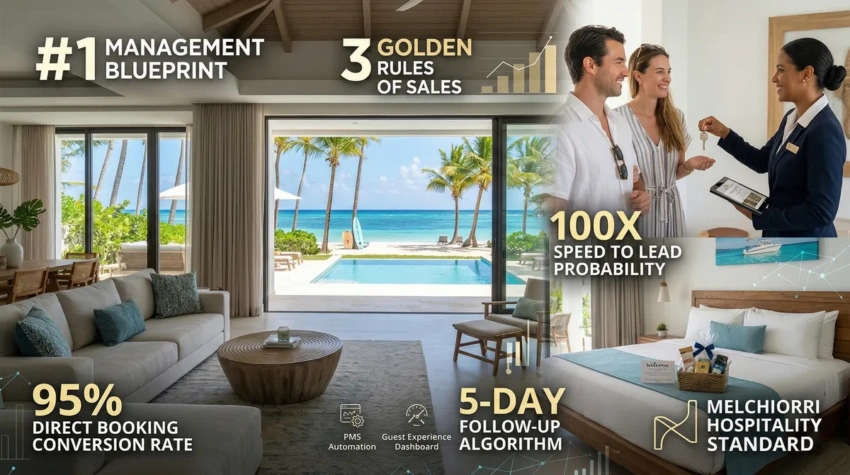
Uplifting guest experience in the short-term rental industry
Let us examine the hidden mechanisms of customer experience management, the architecture for managing inbound inquiries, the linguistic and psychological analysis of scripts, and the fundamental “golden rules” of sales that determine the final conversion rate of potential leads.
Video on Airbnb Engagement Strategies and Closing Deals
1. Short-Term Rental Management Architecture
and the “Inbox Zero” Paradigm
The first and most critical stage in the operational cycle of guest interaction is the effective management of incoming messages. Internal corporate protocols strictly regulate inbox hygiene and implement the “Inbox Zero” philosophy. This approach is not merely a routine administrative task, but a fundamental operational strategy for efficient short-term rental management.
Psychological aspects of information unloading
The company’s training materials explicitly state a requirement for staff: “So, what I want you to do is to archive everything that was before 2026”. Absolutely all old inquiries and correspondence that do not require further active steps must be immediately archived.
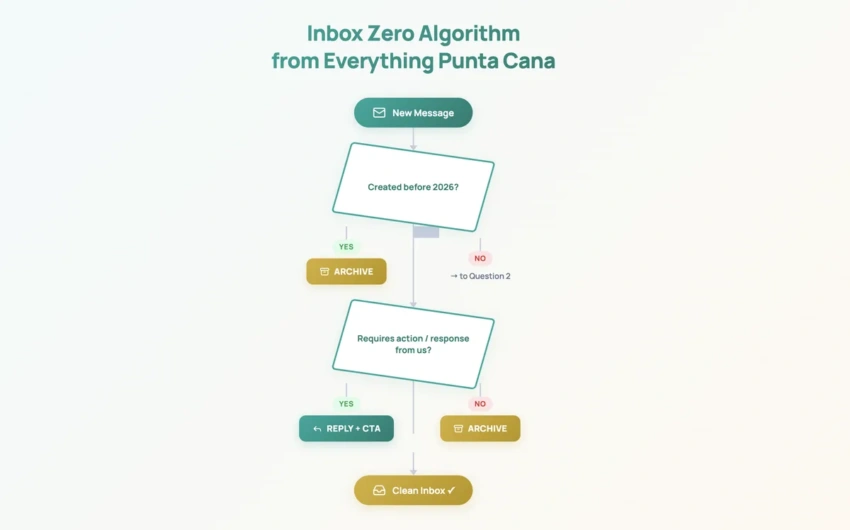
Inbox Zero operational flow
This methodological approach finds deep validation in modern cognitive psychology research. A cluttered, unstructured inbox causes decision fatigue among employees. According to the concept developed by Merlin Mann, the creator of the “Inbox Zero” concept, “zero” refers not to the number of emails, but to the amount of time and cognitive load an employee’s brain expends on the inbox.
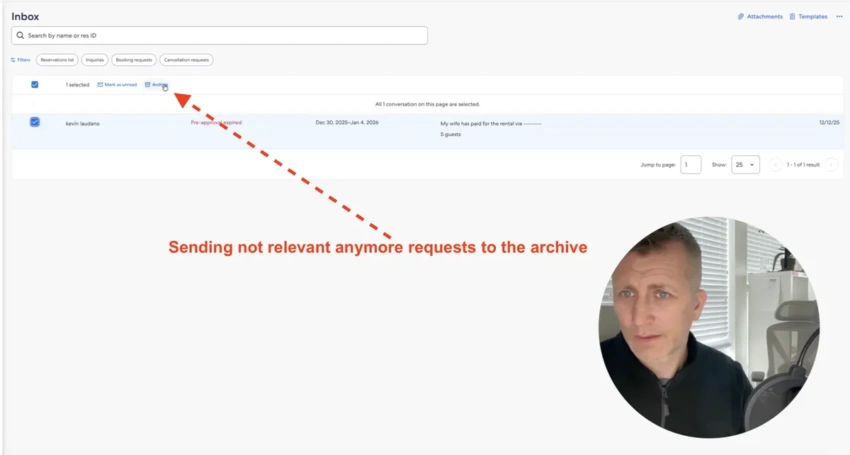
Removing non-relevant requests to stay focused
Advantages of archiving:
- Cognitive load reduction. The employee focuses exclusively on warm leads.
- Error minimization. Visual noise reduces concentration, which is unacceptable when handling VIP clients.
- Data preservation. Archiving on platforms like Airbnb does not permanently delete the correspondence; if a guest writes again, the thread is automatically restored.
The unified inbox as a scaling tool
In the STR industry, communication occurs across multiple channels: Airbnb, VRBO, Booking.com, WhatsApp, and email. In 2025-2026, guest loyalty management is won through speed and hyper-personalization.
The use of a Unified Inbox allows Everything Punta Cana managers to avoid switching between tabs and platforms. This eliminates human error and ensures that not a single message falls through the cracks.
Algorithmization of booking status processing
An analysis of the company’s internal processes reveals a strict, multi-step operational algorithm. For clarity, the primary inbox management scenarios and their corresponding quotes from the training video are summarized in the table below:
4 inbox management scenarios
| Inquiry status | Manager’s action | Regulated quote (from video) |
|---|---|---|
| Confirmed bookings | Checking past requests, resolving logistical issues, and sending a welcome message | «I want to make sure that everything is organized as you expect… I want you to be happy.» |
| Cancellations | An empathetic response, maintaining loyalty and an “open door” | «If you ever change your mind, we are waiting for you… You are always welcome.» |
| Pre-approval expired | Sending a special offer with a discount to stimulate a response | «Send a special offer, let’s say $1 or less… We should try to make sure that we use all chances.» |
| Old inquiries | Attempt to close a dialog with a benefit (review or subscription) before archiving | «Archive everything that was before 2026… ask them for the follow-up, for the review… or subscribe to our YouTube channel.» |
2. Proactive Follow-Up and Shaping the Guest
Experience in Short-Term Rental Management
The modern luxury hospitality industry has transitioned from a reactive service paradigm to proactive anticipation of needs. An analysis of EPC’s scripts demonstrates a phenomenally deep understanding of consumer psychology.
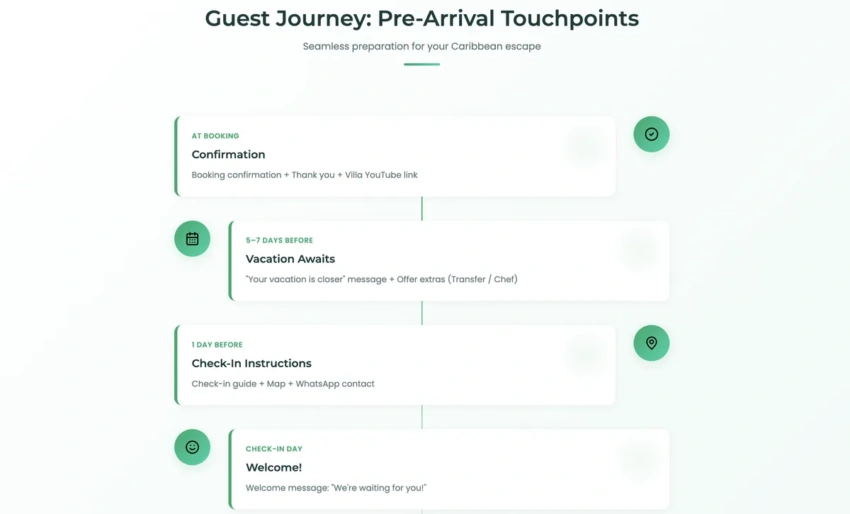
Seamless preparation for your Caribbean escape
The psychology of pre-arrival support
Establishing warm contact before the guest’s physical arrival solves several business objectives simultaneously. It reduces client anxiety, minimizes the number of chaotic questions on check-in day, and opens a window for cross-selling.
The template recommended sounds like this:
“Hi, Ken. Your vacation is coming closer. I want to make sure that everything is organized as you expect. Feel free to contact me. We’ll take care of anything you might need. I want you to be happy.”
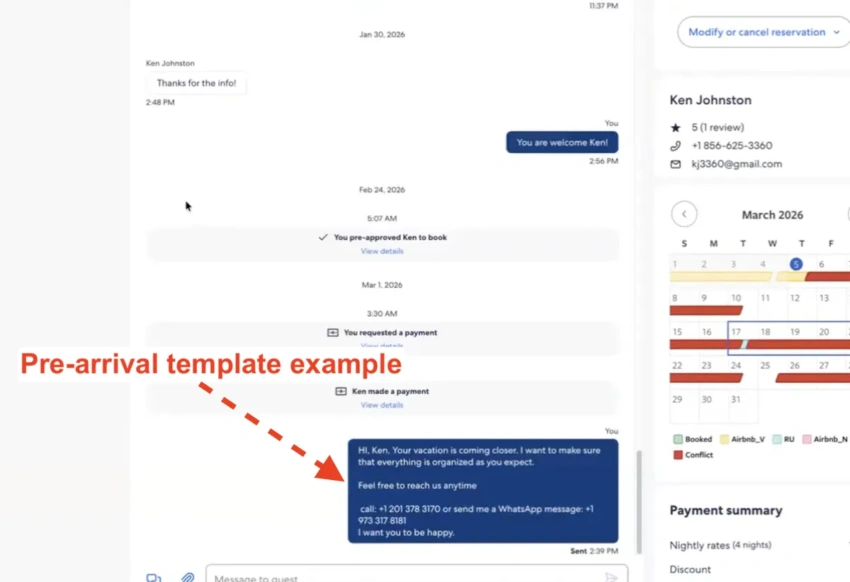
Proactive support before the guest’s arrival
The phrase “I want you to be happy” masterfully shifts the focus from dry transactional communication to an emotional promise of a result. The guest understands that the company is investing in their emotions and comfort. An effective pre-arrival message, sent a few days before check-in, must always include:
- Precise property access instructions (lock codes);
- Parking location;
- High-speed Wi-Fi access details;
- A link to the Digital Guidebook.
Upselling and cross-selling strategy
Offering to ensure that “everything is organized as you expect” opens a natural pathway for selling high-margin services. Upselling (category upgrades) and cross-selling are the invisible profit drivers in modern short-term rental management.
A well-executed timeline for distributing offers looks like this:
- Booking process. Offering premium packages.
- Prior to arrival. The ideal time for logistical services (airport transfers, early check-in, grocery delivery).
- During the stay. Personal chef services, golf cart rentals, and organizing excursions (ziplining, buggy rides).
By selling these services prior to arrival, when the guest is in a state of joyful anticipation, the company increases the total transaction value and boosts RevPAR (Revenue Per Available Room) without creating a sense of intrusiveness.
Handling cancellations and the service recovery paradox
A booking cancellation is often perceived as a definitive loss. However, EPC’s protocols view a cancellation as an investment in the customer’s lifetime value (LTV). The manager actively “leaves the door open.” In an environment of colossal competition, preserving human relationships is critically important.
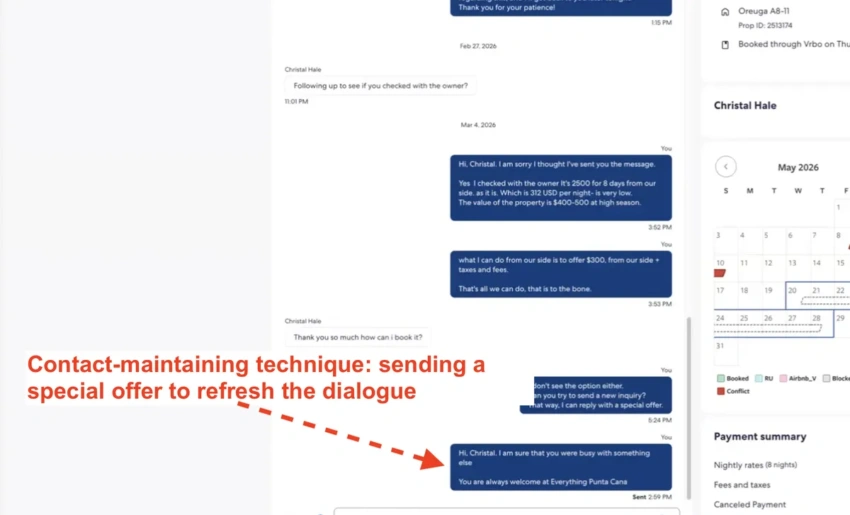
Example of the usage of special offers in communication to increase conversion
Even more interesting is the strategy of reactivating old threads where an audit revealed that the service was less than ideal. The speaker in the video instructs the staff to use the following approach:
“I’m reviewing previous communication, and I would love to improve from our side as henceforth… We are waiting for you. You are always welcome.”
Acknowledging shortcomings triggers the so-called Service Recovery Paradox. A client whose problem was openly acknowledged and empathetically resolved demonstrates a higher level of loyalty than one whose experience was routinely flawless from the start.
3. Communication Standard:
Anthony Melchiorri’s Philosophy
The company’s short-term rental management sets an extremely high bar, requiring correspondence to be conducted in the style of Anthony Melchiorri. Melchiorri is a cult figure in hospitality with 20 years of experience in hotel crisis management and is the host of the show Hotel Impossible.
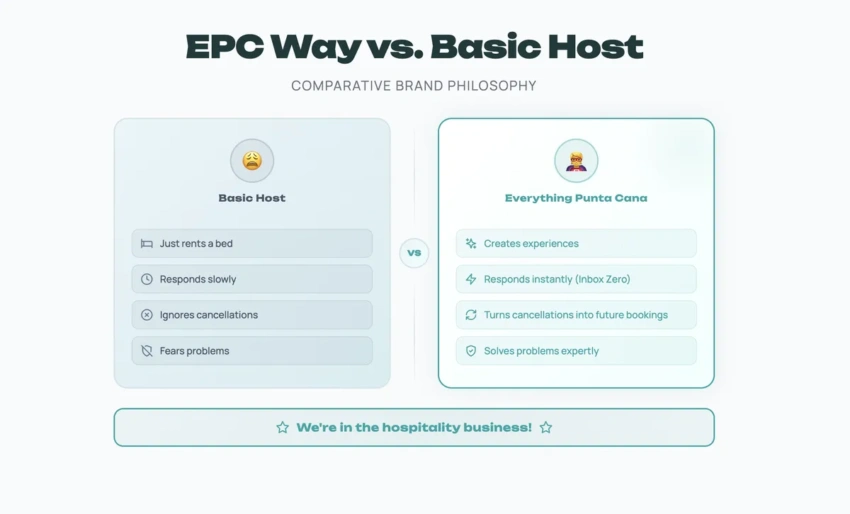
Professional vs. basic hosting approach
The video provides a clear instruction:
“Act as a professional hospitality manager with 20 years of experience. Act like Anthony Melchiorri, the host of Hotel Impossible. And respond to the guests in Spanish in a very polite and nice way. Organize communication with bullet points or, even better, with numbers. Bring absolute clarity and friendliness.”
The ‘Show up’ concept & five steps to outstanding service
Understanding this corporate standard requires deconstructing Melchiorri’s philosophy, outlined in his book Show Up: The Five Steps to Getting Out of Your Own Way. The concept is based on the difference between simply “standing up for yourself” and truly “showing up” and taking 100% responsibility for the guest’s experience.
According to Melchiorri, the 5 fundamental steps include:
- Remaining authentic and true to yourself.
- Taking inventory of who you are and how the world sees you.
- Identifying your strengths.
- Doubling down on developing those strengths.
- Not letting others define your boundaries.
In the context of EPC’s operations, this means an absolute refusal to make excuses. If a guest has a problem, the manager must resolve it instantly, without shifting the blame onto circumstances or other employees.
Eye contact, structure, and information control
Written communication, according to the instructions, must reflect Melchiorri’s key principles:
- Absolute structural clarity. The use of bullet points or strict numbering when conveying any organizational information. Solid walls of text are ignored by guests.
- Impeccable politeness and boundaries. Communication must be professional and friendly, yet radiate confidence. This is a “tough love” style, where safety and cleanliness standards are non-negotiable.
- Brand identity. The directive requires always mentioning the company’s full name, “Everything Punta Cana.” It protects against depersonalization on OTA (Online Travel Agencies) platforms and builds recognition for direct bookings.
- Deep product knowledge. As Melchiorri asserts, a general manager’s power stems from knowing every detail of their property.
Motivation through the environment
Another Melchiorri principle is: “I don’t motivate people.” Management’s task is to hire extraordinary employees with potential and create an ecosystem for them where they will inherently want to give 100%.
The instruction shown in the video is part of such a transparent ecosystem: the employee is given explicit scripts, clear expectations, and a solid understanding of the brand’s philosophy.
4. Objection Management and Myth Deconstruction
(The Psychology of Fears)
One of the most difficult tasks in resort real estate marketing is overcoming subjective fears and myths. The training video provides an example where guests refuse to book properties due to an irrational belief that “the ocean is cold or dangerous.”
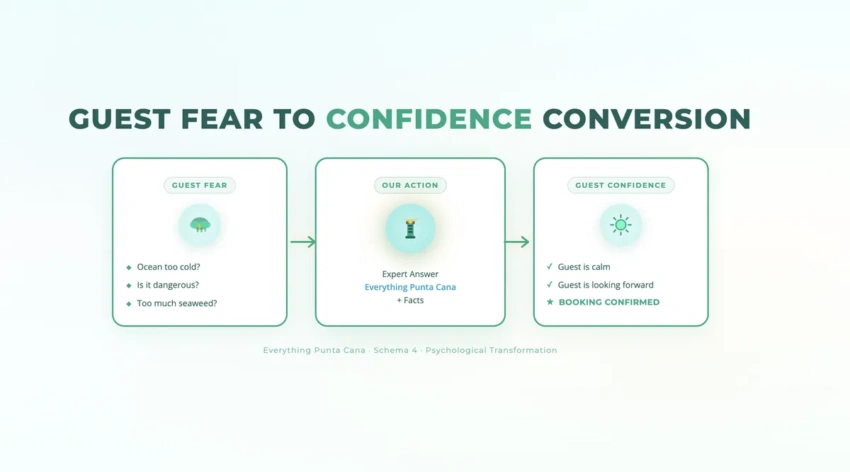
Psychological guest transformation process
Destroying the ‘cold ocean’ myth
Managers are instructed to systematically dispel these concerns:
“The truth is that they think it’s going to be cold or they think it’s not going to be safe. The ocean… It’s warm and very transparent.”
From the perspective of water safety science, temperatures below 21°C (70°F) require caution, while temperatures below 15°C (60°F) trigger dangerous “cold water shock.” The reality in Punta Cana is drastically different. An analysis of data shows that the ocean temperature is ideal year-round:
Climate peculiarities in Punta Cana
| Climate season | Average ocean water temperature | Swimming comfort assessment |
|---|---|---|
| Winter (Jan – Mar) | 26°C (79°F) | Refreshing yet completely comfortable for all sports |
| Spring (Apr – May) | 27-28°C (80-82°F) | Ideal warming, suitable for long baths |
| Summer (Jun – Oct) | 28-29°C (83-84°F) | The effect of “steamed milk”, crystal visibility |
| Autumn (Nov-Dec) | 27-28°C (80-82°F) | Very warm, calm waters, ideal for children |
Using these precise numbers in correspondence moves the dialogue from the plane of irrational emotions to the plane of indisputable facts.
Beach safety and the flag system
The issue of safety in the Dominican Republic is often fueled by the media. However, resort areas (Bavaro, Cap Cana, Uvero Alto) operate as a “safe bubble.”
To professionally address the fears, experts in short-term rental management must explain the next aspects to clients:
- The presence of POLITUR. This is a specialized tourist police unit that conducts massive, round-the-clock patrols of resort arteries and beaches.
- The warning flag system. Guests need to understand that water safety is monitored. A green flag indicates it is safe, a yellow flag means medium danger (currents), a red flag means swimming is prohibited, and a purple flag indicates the presence of marine life (jellyfish).
- Gated communities. Most “Everything Punta Cana” properties are located in elite, gated complexes with 24/7 paramilitary security.
Tap water quality and sargassum seaweed
Two other common fears are tap water and seaweed.
Guests must be told clearly but politely that drinking tap water in the Dominican Republic is not advised. However, the ice in drinks at resorts and restaurants is absolutely safe, as it is made from deeply purified, filtered water.
The Sargassum seaweed issue is also manageable. Its peak season typically runs from May to October.
A professional host always provides an honest assessment of the beach situation, offering relaxing stays by luxurious private villas or excursions to seaweed-free islands (e.g., Saona Island) as alternatives.
5. The Three Golden Rules of Sales in a
Competitive Short-Term Rental Management Environment
The culmination of the training video is the formulation of three fundamental, non-negotiable rules (The Three Golden Rules) that are mandatory for execution. These rules represent a concentration of the world’s best B2C sales practices.
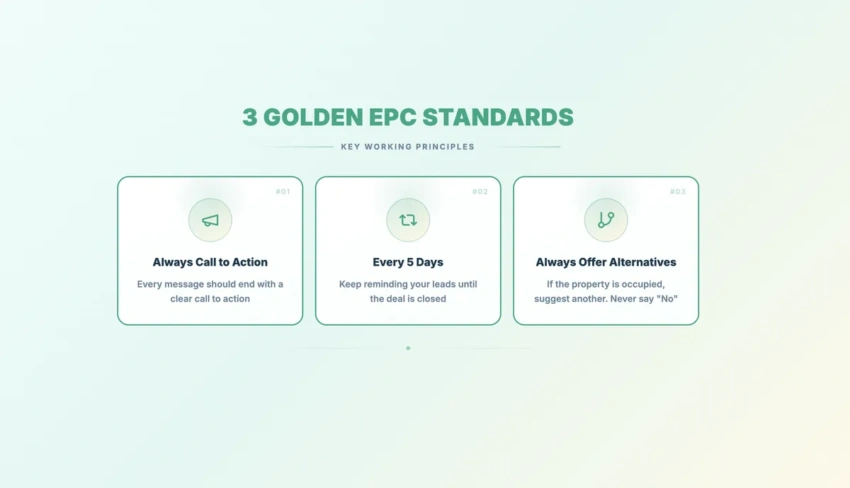
Key working principles for rental sales
Rule 1: the call to action (CTA) imperative
“Every dialogue with the customer must end with a call to action.”
From a behavioral psychology perspective, ending a dialogue without a CTA disrupts the user journey. The client must always be prompted with the next step. The call to action should organically vary depending on the “temperature” of the lead:
- Research phase. Using low-stress CTAs (Low-obligation CTAs), for example: “Learn more about our villas” or “Watch our YouTube video.”
- Ready to book (warm lead). A hard CTA to close the deal: “Book your dates now.”
- Pre-arrival. Offering additional services: “Check out our chef’s menu” or “Book a transfer.”
- Post-stay. Requesting a review.
Review request strategy. Airbnb statistics prove that every 5-star review leads to a 3.2% increase in Gross Booking Value (GBV) and a 4.6% growth in future bookings the following year. To secure a review on Google Maps, the best practices of 2025-2026 dictate sending a personalized SMS or email with a direct link (or QR code) within 24-48 hours after checkout.
YouTube subscription. Asking guests to subscribe to the corporate channel (where the company already has nearly 13,000 subscribers) is a powerful tool for long-term retention. Dynamic reviews of villas and excursions keep the guests’ interest warm for free until their next vacation.
Rule 2: response time architecture – 5 days and the “speed to lead” principle
“Every lead must be followed up on within 5 days.”
This rule requires deep consideration. In sales, there is a strict “Speed to Lead” principle. The statistics are compelling:
- A manager who responds to an inbound inquiry within the first 5 minutes increases the probability of successful lead conversion by 100 times compared to one who waits 30 minutes.
- Approximately 78% of deals go to the company that responds first.
- Paradoxically, the industry average response time is catastrophic: 42-47 hours.
If speed is so critical, why does management speak of 5 days? The reality is that 5 days is the window for strategic follow-up (subsequent touchpoints).
Research shows that 80% of successful B2B and B2C deals require a manager to make at least 5 consecutive touchpoints after the initial contact. At the same time, 44-48% of salespeople give up after the very first attempt.
The ideal 5-day follow-up algorithm
| Follow-up Day | The purpose of communication touch | Recommended manager action | Expected result |
|---|---|---|---|
| Day 1 (0-5 min) | Instant hot lead capture | Direct, structured response on the OTA platform | Maximum probability of closing a deal (Speed to Lead) |
| Day 2 | Providing additional value | Submitting a video review to YouTube (e.g. A5) | Warming up interest, visual engagement |
| Day 3-4 | Identifying hidden needs | A quick question to clarify logistics or services | Resuming dialogue, removing objections |
| Day 5 | Final CTA before archiving | Offering social media subscriptions or alternative dates | The ultimate solution or Inbox Zero |
This rule acts as a safety net: no client is lost simply because a manager forgot to write to them.
Rule 3: portfolio liquidity and the uncompromising offer of alternatives
“If something is not available, always offer the alternatives and always close the deal.”
An inexperienced agent simply turns the client away. A professional one uses a rejection as a launching pad. A lost lead for one property is already a “warmed-up” buyer with a known budget and dates.
The manager must instantly offer 2-3 comparable options from the company’s portfolio. This ensures the flow of demand within the company’s own assets and maximizes overall revenue.
Setting up these automated follow-up sequences and cross-selling funnels requires deep market expertise. If you want to audit your current operations and implement these exact revenue-generating strategies, our experts can help.
Get Expert Vacation Rental Consulting
6. Operationalizing Boutique Management
Using Premium Assets as an Example
In the finale of the training video, sales priorities are explicitly set:
“Our priorities, Villa Waterfall, Villa Desiree. Villa Main, Oreuga, Gassie. This is it.”
The short-term rental management of elite villas is based on the boutique management concept. Each flagship villa has its own USPs (unique selling propositions), which the manager must masterfully utilize when offering alternatives (Rule 3).
Examples of EPC’s villas and their UPSs
| Flagship property | Key architectural / design features | Ideal target audience |
|---|---|---|
| Villa Waterfall | 5 bedrooms, indoor waterfall, elegant modern open-space design | Groups of friends, connoisseurs of modern luxury, adult groups |
| Villa Desiree | 5 bedrooms, integrated children’s playground (slides, swings), three dining areas | Large families with children, multigenerational groups who value comfort and control |
| Ocean-view Apartments (Oreuga, Gassie, A5) | Direct beach access, breathtaking panoramic balconies | Romantic couples, small groups, beach lovers |
Cross-selling scenario. If a family with small children requests the stylish Villa Waterfall, but it is fully booked, the manager immediately offers Villa Desiree, emphasizing the private playground where children can play safely within sight of their parents relaxing in the BBQ area.
7. Technology, Humanity, and the Hybrid Approach of 2025-2026
In the modern realities of 2025-2026, scaling such processes is impossible without automation in short-term rental management. PMS (Property Management Systems) and triggered messaging handle the routine: the automatic sending of door codes, Wi-Fi passwords, and trash disposal instructions. The use of AI tools allows for instant (within 1 minute) sentiment analysis of guest messages and the generation of draft responses.
However, as Anthony Melchiorri tirelessly repeats: “Technology will never replace how you treat people.”
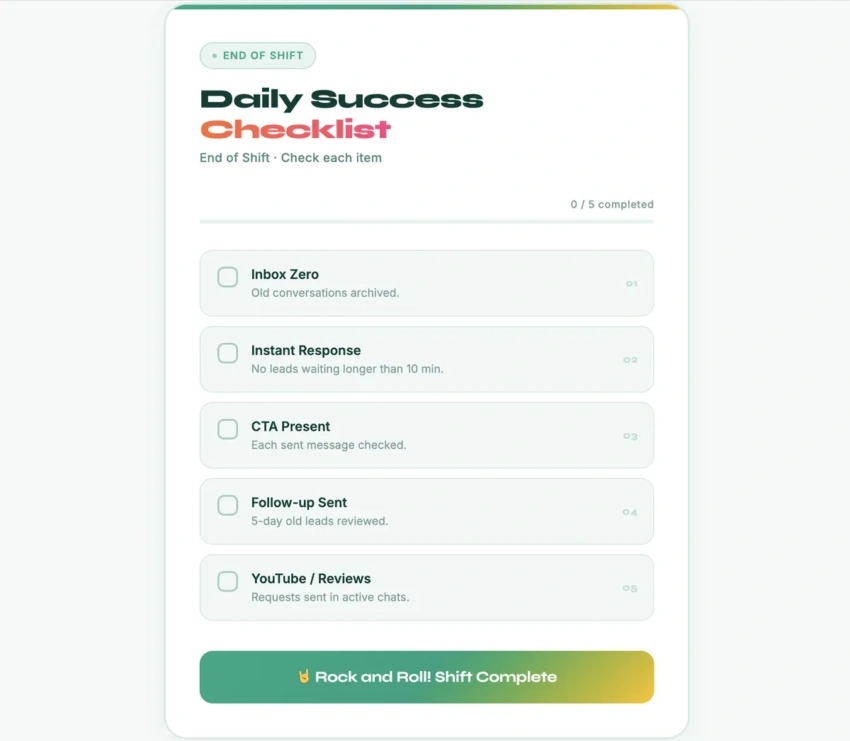
The difference between simply renting a bed and creating an elite guest experience
Automation (sending saved templates, such as OfferServices or 5-star reviews) is designed to fulfill only one task: to free up employees’ time. This saved time should be directed toward:
- Resolving complex, non-standard situations.
- Showing genuine human empathy when handling complaints and issues.
- Providing personalized concierge service (booking yachts, organizing personal chef services, free time).
Conclusion
The analysis of EPC’s operational model reveals a highly efficient, mathematically and psychologically calibrated management mechanism in the luxury sector. Effective short-term rental management ensures information hygiene through “Inbox Zero,” protecting staff from burnout. Proactive pre-arrival communication builds trust and generates profit through smart upselling.
Strict adherence to the golden rules – integrating a CTA, maintaining tight control over the 5-day follow-up, and mandating the offer of alternative villas – makes the sales department a powerful revenue generator. Implementing these rigorous standards independently can be overwhelming, which is why many owners choose to delegate their assets to expert property management professionals who already have these proven protocols in place.
Explore Our Property Management Services
The combination of advanced CRM technologies with an uncompromising level of personal responsibility in the style of Anthony Melchiorri allows the company to provide guests not just with a place to sleep, but with an emotion that brings them back time and time again.
Frequently Asked Questions on
STR Management in 2026
What is short-term rental property management?
This comprehensive property management service is available for rentals ranging from one night to a month. Unlike long-term rentals, the focus here is on hotel services:
- Marketing and listing management on OTAs (Airbnb, Booking.com).
- Dynamic pricing and incoming lead management.
- Maintenance, cleaning, and procurement.
- Guest experience nanagement (24/7).
How do you manage a short-term rental?
Effective management is based on three pillars:
- Automation. Using PMS systems to synchronize calendars and pricing.
- Communication standards. Using the Inbox Zero algorithm and quick responses (up to 10 minutes).
- Quality control. Regular checklists for cleaning and technical audits of the facility before each visit.
What exactly is a short-term rental?
A vacation rental is a residential property (a house, apartment, or villa) rented for short periods, typically less than 30 days. Its main difference from a hotel is the inclusion of home-like amenities, such as a kitchen and private areas, while maintaining a high level of service.
What are common problems with short-term rentals?
The main risks we assume are:
- Downtime. Ineffective marketing or lack of lead generation.
- Wear and tear. High traffic requires constant minor repairs.
- Negative reviews. Most often caused by poor communication or inconsistencies between photos and reality.
- Guest objections. Concerns about safety or climate (e.g., sargassum in the Dominican Republic).
Is 3 months considered short-term?
Technically, this is a mid-term rental.
- Short-term is up to 30 days (tourism trips).
- Mid-term is from 1 to 6 months (digital nomads, relocation).
However, the management processes (cleaning, support) remain similar to the short-term model.
What makes a good short-term rental property?
A successful property is defined by the formula: Location + Concept + Service.
- Location. Proximity to popular attractions (beaches, airports).
- Concept. Instagram-worthy design and unique features (such as a private pool or terrace).
- Amenities. High-speed Wi-Fi, high-quality linens, and a coffee machine.
What type of rental property is most profitable?
Boutique Villas and uniquely designed apartments in prime locations (such as Punta Cana) demonstrate the highest ROI. A personalized approach to each guest allows us to maintain prices above market value, even during the off-season.
How much money do I need to invest to make $3,000 a month?
The amount depends on the region and strategy:
- If you own a property, $3,000 is the net profit for a villa worth $350,000 to $500,000 with proper management.
- If you use subletting (rental arbitrage), the investment could be $20,000 to $40,000 (furniture, decor, first month’s rent) to achieve this level of income from multiple properties.
What is the difference between an Airbnb and a short-term rental?
Airbnb is just a marketplace. Short-term rentals are a business.
Professional companies use Airbnb as just one channel, seeking to increase the share of direct bookings through their own websites to save on commissions.
What is the 80/20 rule for Airbnb?
In a management context, 80% of your revenue comes from 20% of your efforts.
- This 20% is driven by loyalty, promptly processing incoming requests, and high-quality content.
- This could also mean that 80% of your profits come from the 20% of most popular dates (high season).
What is the 6-year rule for Airbnb?
This is a tax rule (mostly relevant to Australia and some European countries) that allows you to treat a home as your main residence (and not pay capital gains tax) even if you rent it out for up to 6 years, provided you do not live there.
What do people use instead of Airbnb?
Main competitors and alternatives of Airbnb are:
- Booking.com. Leader in Europe and among hotel-type accommodations.
- VRBO. Popular with families and for renting entire homes.
- Direct booking websites. Websites of property management companies (like ours), where prices are lower due to the absence of platform fees. For instance, Everything Punta Cana.
- Expedia / Google Travel.
Is there a 90 day limit on Airbnb?
Yes, some cities (for example, London, Paris, and San Francisco) have imposed restrictions on entire property rentals. The Dominican Republic currently has no such strict restrictions, making this market extremely attractive to investors.
Updated on: . Author: