
Vacation Rental Revenue Management & Guest Communication – The Essential Guide 2026
Mastering vacation rental revenue management is vital, as high-quality, clean, and stylish accommodations are just the bare minimum in the industry. Professional communication and guest experience optimization are becoming the real drivers of high occupancy, vacation rental revenue management, and return on investment (RoI).
A reservations manager is no longer just someone who confirms dates. They are trusted advisors, psychologists, and sales experts. Their ability to build a trusting dialogue in chat, handle challenges and doubts, apply influence triggers, and subtly offer additional services (upselling) determines the success of the entire business.
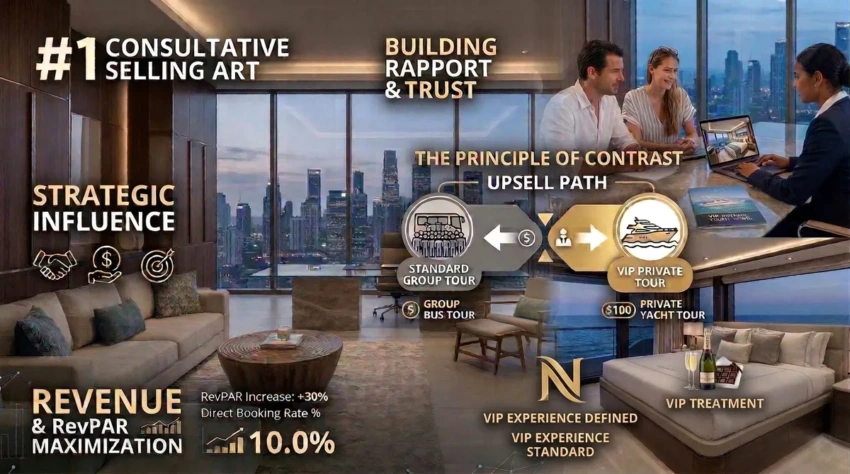
The architecture of successful vacation rental revenue management: combining consultative sales and the contrast principle
This article, based on an in-depth analysis of real-life customer interaction scenarios, reveals advanced communication, lead qualification, and sales methodologies applicable to daily work on the Airbnb, Vrbo, and Booking.com platforms.
Video on Advanced Follow-Up Strategies and Lead Management for Short-Term Rentals
1. Vacation Rental Revenue Management & OTA Algorithms:
How “Speed Currency” Impacts RevPAR
The first and most rigorous rule of successful sales on Online Travel Agencies (OTA) platforms is response speed. In the hospitality industry, response time directly translates into money.
Technical aspect: how algorithms evaluate communication
In 2025-2026, the search algorithms of Airbnb, Vrbo, and Booking.com shifted their focus from simple views (clicks) to trust and conversion metrics. These platforms only earn money when a booking occurs. If the algorithm detects that a host is responding slowly, it lowers their rating, as slow responses kill conversions.
- Booking.com and the Reply Score. This platform uses a strict metric called the “Reply Score.” It reflects the % of guest messages the host responded to within 24 hours over the past 30 days. A high score increases a property’s visibility and is directly correlated with a lower cancellation rate.
- Airbnb and the impact of speed on conversion. Analytics show that successful hosts who respond within one hour receive 25% more instant bookings. Moreover, improving your response rate from 89% to 100% can lead to an impressive 116% increase in bookings. To maintain Superhost status, the platform requires maintaining a response rate of at least 90%.
A unified box as a practical solution
In the video, the manager processes a huge influx of messages. To avoid going crazy, comply with algorithmic requirements, and optimize vacation rental revenue management, professionals use Unified Inbox systems. This is property management software (PMS) that collects messages from all platforms (Airbnb, Vrbo, Booking, and direct websites) into a single window.
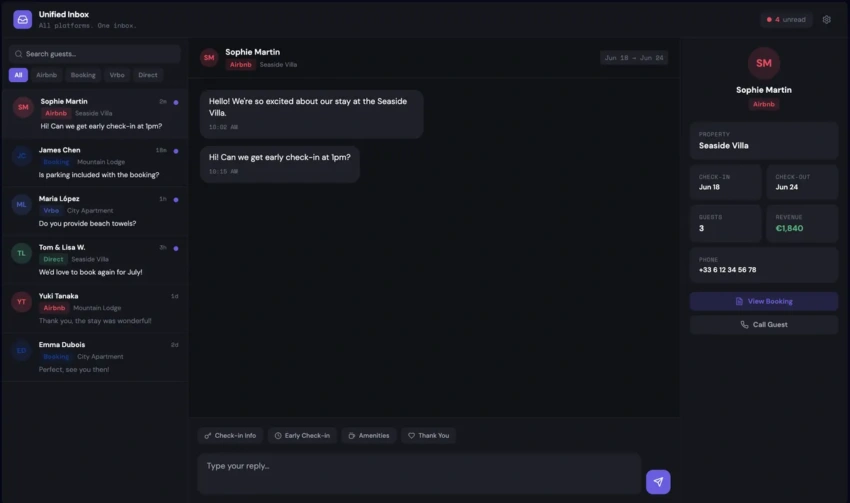
A Unified Inbox with messages from all OTA platforms in a single window
This allows for instant response to requests, the use of templates with auto-filled names, and the avoidance of wasting precious minutes switching between applications.
2. Lead Management Tactics for Better
Vacation Rental Revenue Management
One of the main challenges for a booking manager is managing attention. When dozens of inquiries arrive daily, trying to devote equal time to them all will lead to burnout and the loss of “hot” clients.
In the video, we see a brilliant example of the Binary Visual Lead Qualification, or the Star/Archive Method. This is a CRM (Customer Relationship Management) system adapted for quick messaging.
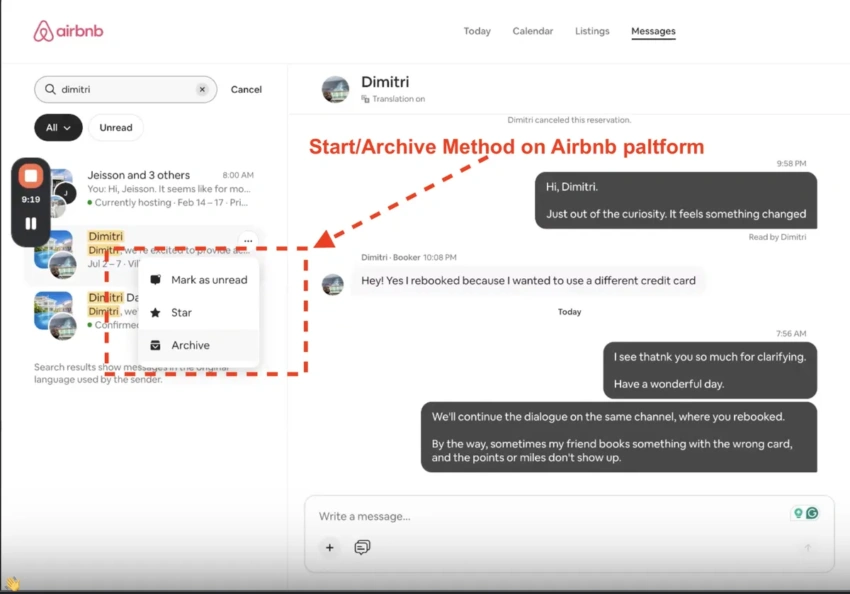
The Star/Archive lead qualification method inside the Airbnb inbox
How the binary visual lead qualification method works
The manager pronounces his algorithm: “Everything, whatever it is, doesn’t make sense to make a star… You put it in the archive like this. Everything with which you can close the deal… You go in filtering one by one.”
This system divides the entire flow of communication into two rigid categories:
1. Category “Star” (high-intent leads)
Conversations are marked with a visual marker (star/flag) if they require immediate operational intervention and have a high transaction potential.
How a manager defines a “hot” client (qualification):
- Clear parameters. The guest begins discussing a price range or requests specific dates (“from April 5th to April 7th”).
- Financial specifics. In the example with client Albert, the manager notes: “We work only with USD or Dominican pesos… he is aware, believe me, that’s okay. So. Star. Because this message requires a response.” Clarifying the currency and payment terms is a classic signal of readiness to make a deal (Buying Signal). The manager concentrates 90% of their efforts on this group.
2. Category “Archive” (nurturing / pending demand)
If a message is purely informational (for example, a client writes, “Thank you so much for clarifying”), the conversation is immediately archived. This is necessary to clear the manager’s visual field and keep the focus on the money.
The most important nuance (second-order thinking):
Archiving isn’t deletion. In the professional sales management paradigm, the archive serves as a basis for remarketing. The manager in the video comments on this: “If they respond perfectly, we have a dialogue where we can sell and offer services. If not, we can go back and offer services there.”
Meaning: even if the guest rented accommodation elsewhere (or the deal didn’t close), the communication channel is already open. The manager uses this archived database later to send offers for additional services (e.g., excursions). This maximizes the value of each contact.
3. The Psychology of Consultative Selling
in Premium Rentals
The villa rental industry isn’t a mass-market industry. Pushy sales methods don’t work here. Consultative selling is used – an approach in which the seller acts as an expert and trusted advisor, whose goal is to understand the client’s deepest needs and find the ideal solution.
According to research, 85% of purchasing decisions are based on emotion. A consultative approach taps into the customer’s emotional state.
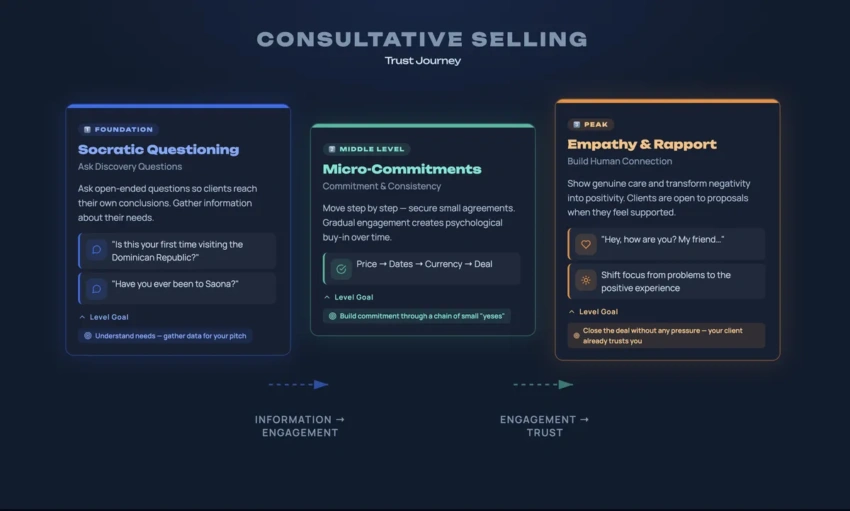
he Trust Journey: Socratic questioning, micro-commitments, and empathy in premium rentals
Technique 1: Socratic questioning
Instead of bombarding the client with links to villas, the manager asks open-ended, guiding questions. This is an ancient psychological technique – Socratic dialogue – that forces the client to come to the desired conclusions on their own.
In the video, the manager uses this technique when selling a tour:
- “Have you ever been to Saona?”
- “Is that the first time in the Dominican Republic?”
By asking these questions, the manager isn’t selling. They’re conducting discovery. The answer to whether this is the client’s first visit gives the manager a clear roadmap for structuring the rest of the presentation. If the client is new, they need to sell them on safety, comfort, and must-see attractions.
Technique 2: micro-agreement strategy (commitment and consistency)
In Robert Cialdini’s psychology of influence, there’s a principle called “Commitment and Consistency.” It states that if someone agrees to something small, it’s much harder for them to refuse subsequent, larger proposals.
In sales, this method is known as the micro-agreement strategy, or moving in small steps. In the video, the manager says verbatim this: “We communicate one step at a time, one step at a time.” There’s no need to dump all the information, contract terms, and complex booking rules on the client at once. The manager guides the guest through the funnel smoothly: first, the price is agreed upon, then the dates, then the currency, and only then is the deal closed.
Technique 3: transforming negativity through empathy and rapport
Building a rapport is the process of building deep, subconscious trust between interlocutors.
A great example of building rapport in the video is seen in the situation with a client who made a mistake when booking: he used the wrong credit card and didn’t receive his bonus miles (“Books something too with a wrong card. Then points and miles are not there anymore”).
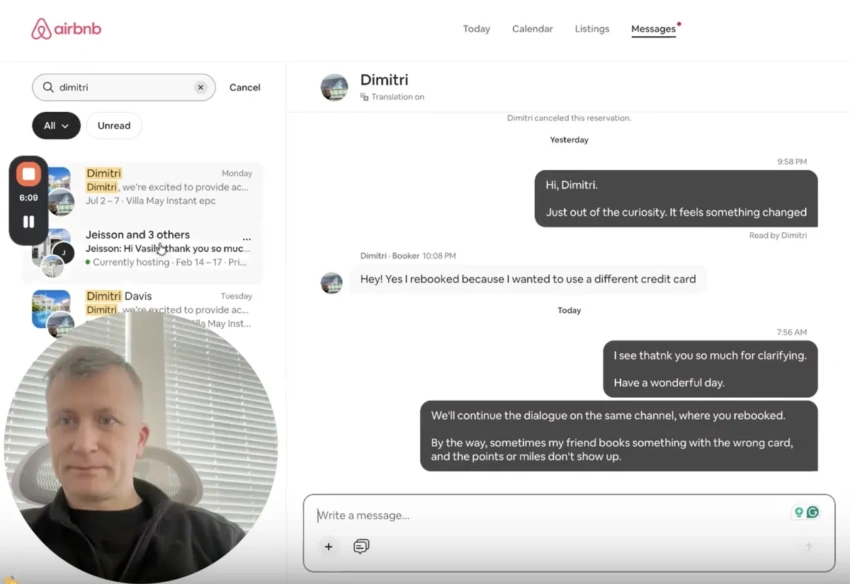
Transforming a negative guest experience into a positive connection through empathy
A bad manager would ignore this message, since the deal is already closed and the guest’s problem is outside the host’s responsibility. What should a professional do?
- Connecting and validating emotions. They open the dialogue with an empathetic response: “Hey, how are you? My friend…” They demonstrate that they understand the guest’s problem and empathize with them.
- Having relieved the emotional tension, the manager naturally shifts the topic from the problem to positive vacation planning: “Have you ever been to Saona?”
Psychologically, a guest who receives support in a moment of frustration feels grateful. The emotional barrier is broken, and the guest becomes more open to purchasing additional services (cross-selling).
4. Handling Complex Requests &
The Minimum Nights Rule
In the context of vacation rental revenue management, situations often arise where business requirements conflict with client desires. For instance, based on our extensive property management experience at Complete Hospitality Management, the most common example we encounter is a request for short-term bookings.
In the video, the manager faces a problem: a guest needs a villa for 2 nights. The manager comments: “The problem is that finding a villa with a two-night minimum is already a challenge.”
Why is 1-2 nights a challenge for luxury properties?
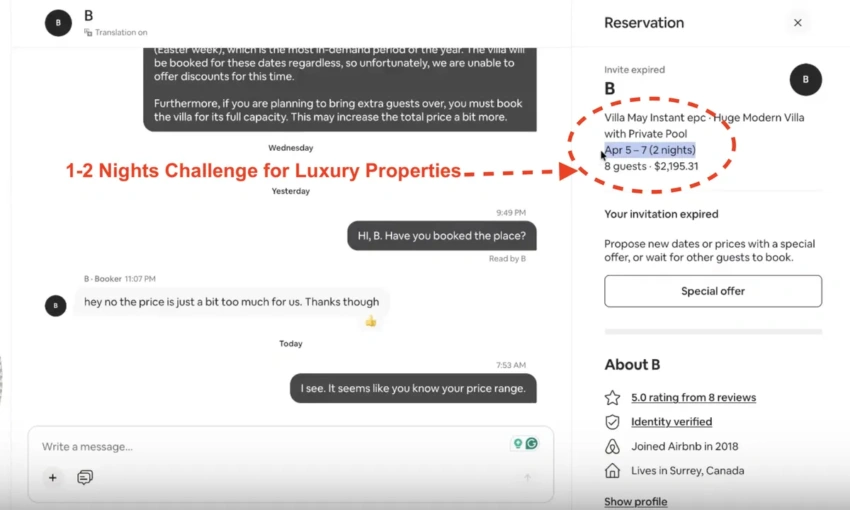
How to politely enforce minimum stay rules without losing the guest’s trust
To understand the mechanics of failure, one must know the economics of the process.
- High fixed costs (turnover costs). Preparing a villa isn’t like cleaning a hotel room. It involves deep cleaning, changing premium linens, hiring a cleaning company, and a technical inspection. For a two-night stay, these costs eat into the entire margin.
- Property protection. Short-term stays are statistically more likely to involve parties, increasing the risk of property damage.
How to communicate such refusals (scripts for handling objections)
The key communication rule here is transparency and a focus on the customer’s benefit (value-driven communication). Never simply answer “No.” Use language that explains the reason in terms of concern for the guest.
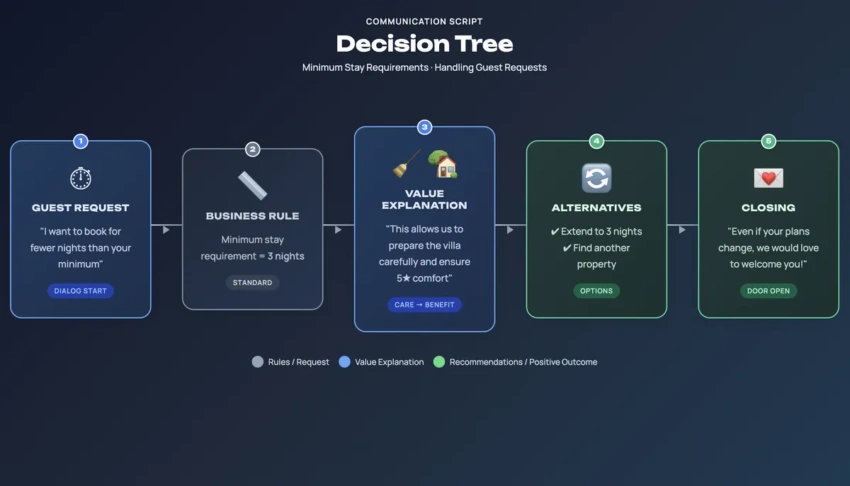
A structured decision tree for handling complex guest requests and minimum stay requirements
Example of an ideal Airbnb/Vrbo chat response:
“Hello, [Name]! Thank you for your interest in our villa. We have a minimum stay of three nights. This allows us to thoroughly prepare the house without rushing, ensuring every guest receives impeccable five-star-level cleanliness and comfort. If your plans change and you decide to extend your stay, we would be happy to accommodate you!”
This response shifts the restriction from the “owner’s whim” category to the “high quality standards” category, thereby increasing the property’s value in the client’s eyes.
5. Upselling Architecture: A Core Pillar of
Vacation Rental Revenue Management
Upselling is an offer to a guest to purchase a more expensive version of a service, while cross-selling is an offer of related products. In the vacation rental industry, successful upselling can increase revenue per booking by 10-30%.
In 2025, 48% of travelers prioritized trips focused on unique experiences and local attractions. Selling these experiences is the host’s responsibility.
The contrast principle and the decoy effect
Analyzing the video, we see a masterful application of the Contrast Principle in selling a tour to Saona Island. The essence of this psychological trigger is that the human brain cannot evaluate things in isolation – it always seeks comparison.
The manager doesn’t simply quote a price for a private yacht. First, he establishes a reference point (a basic anchor) – a standard group tour:
“Regular tour. The transportation. It’ll be so, so. I mean. For the money you pay, it’s perfect. But it’s a bus with stops…”
He doesn’t criticize the cheap tour; he honestly says it’s worth the small price. But then he introduces a sharp contrast – the private tour:
“Private excursions. The VIP version is much, much more pleasurable. With transportation…”
Against the backdrop of the “stuffy bus with stops” description, the price for a private boat no longer seems high to the client; it seems like a price worth paying to preserve his comfort.
Trigger: fear of missing out (FOMO)
This is one of the most powerful tools in a marketer’s arsenal. FOMO stems from people’s fear of missing out on something valuable that others have access to. The manager uses this trigger brilliantly:
“So if you’re going to the D.R. and not going to Saona, it’s a crime. For most people, it’s a life-changing experience… For me, it was before the Saona trip and after.”
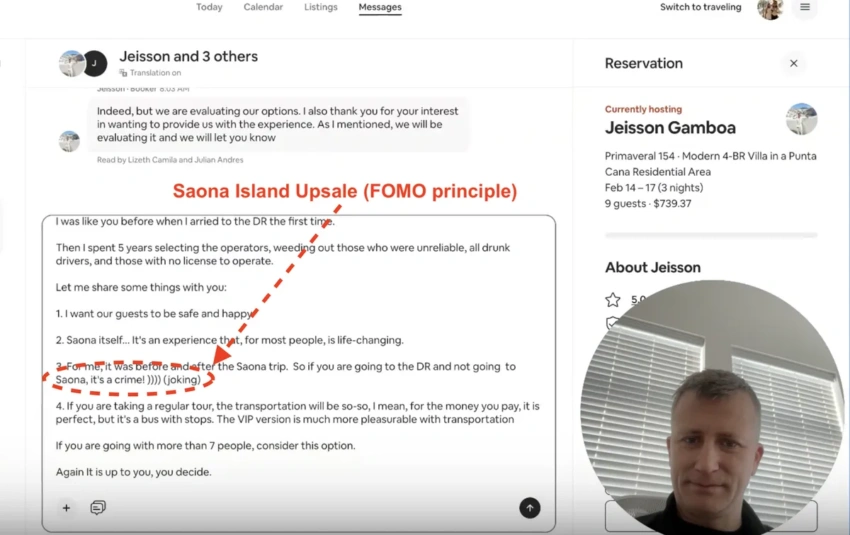
Applying the Fear Of Missing Out (FOMO) psychological trigger to upsell VIP tours
This wording creates a sense of urgency in the client: “If I don’t buy this tour, my trip to the Dominican Republic will be incomplete.”
Trigger: authority
People tend to trust authorities and experts who have done the hard work for them. The manager addresses the high price objection by demonstrating their expertise:
“I spent five years collecting the operators. Weeding out those who are not reliable.”
The client understands they’re not just paying for a boat; they’re paying for five years of someone else’s experience and an absolute guarantee of safety. The phrase ends with a gentle release of pressure: “It’s up to you. You decide. I want you to have a great experience, and I want you to be happy.” This is a classic consultative sales technique: we make a recommendation while leaving control in the buyer’s hands, which builds trust.
6. Upselling Timing and When to
Offer Additional Services?
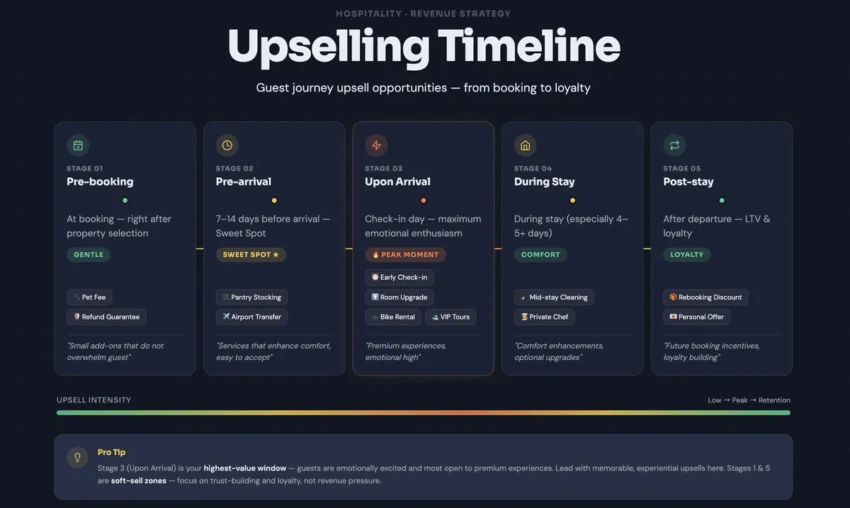
The optimal timeline for offering additional services to vacation rental guests
Offering the right service at the wrong time means rejection. Industry experts identify a timing matrix for upselling:
Upselling timing matrix
| Interaction Stage | Guest Psychological State | Ideal Services to Offer | Metrics & Rationale |
|---|---|---|---|
| Pre-booking (at the time of booking) | The client is extremely sensitive to the final price because they have just paid a large sum for the villa. | Basic packages, such as the option to bring a pet (pet fee) or a money-back guarantee. | Aggressively selling tours at this point will lead to rejection. |
| Pre-arrival (7-14 days before arrival) | This is the “Sweet Spot”. The purchase euphoria has worn off, and the client is thinking pragmatically about logistics like airport transfers and breakfast. | Pantry stocking (filling the refrigerator before arrival) and transfer services. | In 2025, 48% of travelers prioritized trips focused on unique experiences and local attractions. This is the perfect time to start suggesting them. |
| Upon arrival (on the day of arrival) | The guest’s enthusiasm level (“Discovery mode”) is at its peak, making them ready to spend money on emotions. | Early check-in, room upgrades, bike/scooter rentals, and premium excursions like the Saona tour. | In the vacation rental industry, successful upselling can increase revenue per booking by 10-30%. |
| During the stay | The guest is focused on relaxation and avoiding routine tasks. | Mid-stay cleaning for those staying longer than 4-5 days, and a private chef for the evening. | Delivering value here triggers the principle of reciprocity and builds overall Lifetime Value (LTV). |
7. Building LTV (Lifetime Value)
and Reciprocity Trigger
A successful rental property business is measured not by one-time transactions, but by the lifetime value of a customer (LTV). LTV is the total revenue a customer will generate over the years of cooperation. Attracting a new guest through advertising or OTAs is always more expensive than retaining an existing one.
How does the manager in the video work to improve retention and increase LTV? He uses a powerful psychological trigger: the principle of reciprocity. According to this rule, when you give a person something valuable absolutely free, he subconsciously feels the desire to “return the favor.” The manager writes:
“If you want to know more and see some hidden gems… our YouTube channel… If you return to the DR, I will provide you with a very special treatment.”
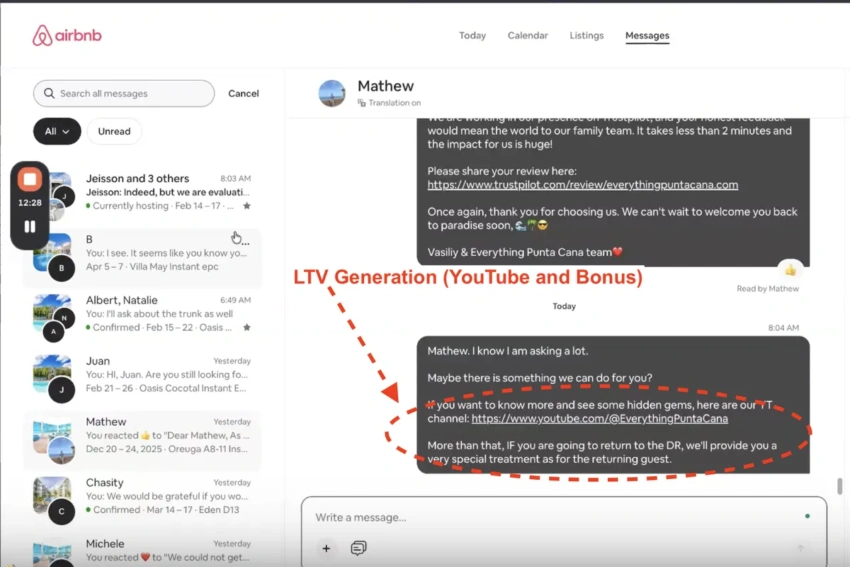
Using free value (the reciprocity trigger) to build LTV and secure direct bookings
Analysis of the “principle of mutual exchange” technique
- Free value. The manager shares insider information (a link to a video about “hidden gems” – off-the-beaten-path locations). Travelers love to feel like explorers, not typical tourists. By providing this information for free, the manager moves from “salesman” to “local friend.”
- Future pacing. The phrase “provide you with very special treatment” primes the client to believe that on their next trip, they don’t need to open Airbnb and look for accommodation. They should contact the manager directly. This forms the basis of a highly profitable direct booking strategy, saving the company 15% to 20% on aggregator platform fees.
Final Thoughts
An analysis of real-world guest experience demonstrates that renting out villas and apartments is an advanced business that requires dedicated vacation rental revenue management. The winning management companies are those that:
- Understand algorithms. Use Unified Inbox and respond within the first hour to maximize trust metrics on Airbnb, Vrbo, Booking.com, and other platforms.
- Qualify leads ruthlessly. Use the “Star/Archive” method to manage focus and conserve energy for those willing to pay.
- Apply sales psychology. Replace pressure with Socratic questions, use the contrast principle to sell VIP services (as in the Saona case), and build rapport through empathy when solving guest problems.
- Think long-term. Provide free value (recommendations, hidden locations) to build loyalty and convert guests to direct repeat bookings.
Implementing these communication standards at every stage of the guest journey is guaranteed to lead to higher average checks, increase occupancy rates, and create a database of impeccable reviews.
If implementing all these psychological triggers, OTA algorithms, and lead qualification systems sounds overwhelming, our team of experts is ready to help. We can analyze your current listings, train your team, and build a custom strategy to maximize your revenue.
Get Expert Vacation Rental Consulting
Frequently asked questions about
vacation rental revenue management
What exactly is vacation rental revenue management?
In the short-term rental industry, revenue management is no longer just about setting nightly rates. It is a comprehensive strategy aimed at maximizing your Revenue Per Available Room (RevPAR) and overall profitability. A successful approach includes:
- Algorithmic optimization. Understanding how platforms rank your listings based on response times and conversion rates.
- Lead qualification. Filtering out time-wasters and focusing your energy on high-intent guests.
- Strategic upselling. Offering premium experiences, early check-ins, or mid-stay cleanings at the exact right moment.
- LTV building. Converting first-time OTA guests into loyal, direct-booking clients.
How does response speed affect my Airbnb and Booking.com rankings?
In the hospitality business, response time is literally “speed currency.” Booking platforms only make money when a reservation is confirmed, so their algorithms actively penalize slow hosts. Here is how speed directly impacts your business:
- Increased visibility. Airbnb and Vrbo push listings with a 100% response rate to the top of search results.
- The reply score. Booking.com strictly monitors your 24-hour response rate; a low score will bury your listing and increase cancellations.
- Higher conversion. Data shows that replying within the first hour can boost your booking conversion rate by up to 116%.
What is the Star/Archive method in lead management?
The Star/Archive method is a binary visual qualification system used by professional reservations managers to handle high volumes of messages without burning out. It divides your inbox into two strict categories:
- Star (high-intent). You flag messages where guests ask specific buying questions, such as date availability or payment methods. You dedicate 90% of your operational focus here.
- Archive (nurturing). You immediately archive purely informational messages (like “Thank you”). However, archiving does not mean deleting. These open channels are saved for future remarketing and cross-selling campaigns.
When is the best time to offer upsells to vacation rental guests?
Timing is the most critical factor in upselling. If you offer a premium yacht tour immediately after the guest has paid a large sum for the villa, they will likely decline. Follow this proven timeline matrix:
- 7-14 days pre-arrival. The guest is thinking about logistics. Offer airport transfers or pantry stocking (grocery delivery).
- Check-in day. This is the emotional peak (“discovery mode”). It is the perfect time to offer room upgrades, early check-ins, or VIP excursions like a Saona Island tour.
- During the stay (days 4-5). The guest is focused on maximum relaxation. Suggest mid-stay cleaning services or booking a private chef for the evening.
How should I handle guests asking for a 1 or 2-night stay in a luxury property?
Accepting 1-2 night stays in premium villas often hurts your revenue due to high fixed turnover costs (deep cleaning, premium linens) and statistically higher risks of party damage. Instead of a flat “no,” use value-driven communication:
- Thank the guest for their interest in your property.
- State your minimum stay rule, but frame it around the guest’s benefit. For example: “This minimum allows us to thoroughly prepare the house without rushing, ensuring you receive impeccable 5-star cleanliness.”
- Gently encourage them to extend their dates to meet the minimum requirement, leaving the door open for a positive outcome.
How to manage a vacation rental remotely?
Remote management requires shifting from a hands-on host to a systems manager. The essentials include:
- Install Wi-Fi-enabled smart locks that auto-generate entry codes for each guest, completely eliminating physical key handoffs.
- Your cleaners are your eyes and ears. Require them to send photos after every turnover. You also need a reliable local handyman for emergencies.
- Use your booking platform or a Property Management System (PMS) to set up triggered messages (booking confirmations, check-in instructions, and check-out reminders).
- Provide a link to a digital house manual so guests can troubleshoot Wi-Fi or appliances without calling you late at night.
What's the best software for managing vacation rentals?
If you are listing on more than one platform (e.g., Airbnb + Vrbo), you need a Property Management System (PMS) or Channel Manager. This software syncs your calendars to prevent double bookings, unifies your inbox, and automates your pricing and messaging.
The “best” software depends entirely on the size of your portfolio and your technical comfort level:
| Software | Best for | Key strengths |
|---|---|---|
| Guesty | Scalability (1 to 100+ units) | Considered the industry standard. It is incredibly robust, reliable, and handles rapid scaling well. (They also offer “Guesty Lite” specifically for hosts with 1-3 properties). |
| Lodgify | Building a Direct Booking Brand | Excellent website builder. If your goal is to bypass OTA (Online Travel Agency) fees and build your own independent brand, Lodgify makes creating a direct booking site very easy. |
| OwnerRez | Control & Transparent Pricing | Favored by detail-oriented hosts who want deep operational control and predictable pricing. It lacks a flashy interface but is incredibly powerful and reliable. |
| Hostfully | The Guest Experience | Known for its integrated, beautiful digital guidebooks and built-in upselling tools, making it great for hosts focused on premium hospitality. |
Don’t buy enterprise software (like standard Guesty or Escapia) if you only have one property. Start with a simpler tool like Smoobu or Guesty Lite, which are cost-effective for small portfolios.
What is the best platform for vacation rentals?
Relying on a single platform is a risky business model. The best approach is a multi-channel strategy utilizing the strengths of the “Big Three”:
- Airbnb is the industry default. Best for urban apartments, unique stays, and reaching the widest possible global demographic.
- Vrbo is like the family specialist. Best for large, entire-home properties in traditional vacation destinations (beaches, mountains) attracting groups booking longer stays.
- Booking.com is the volume driver. Massive internationally, but requires strict cancellation policies as guests often treat it like a traditional hotel booking.
Updated on: . Author: