
How to Change Property Management Company in 2026: Steps, Risks, and Common Fears – Dominican Republic Experience
The switching of a real estate asset between property management companies (PMC) may cause fears and concerns among many owners related to the handover process. However, with over a decade of experience in property management, we know that the fear of change and postponing the resolution of problems with the current management often becomes far too costly.
Declining bookings, poor communication, lack of financial transparency, neglected maintenance, property damage, and the gradual loss of control over the asset are major risks that, as our experience shows, do not disappear on their own – they only become more severe over time. If you are facing these issues, you need a clear, actionable roadmap.
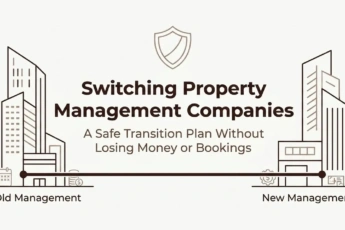
A seamless transition plan to switch your property management company without losing revenue or future bookings
In this article, drawing on our daily experience in property management, we will address each of the 6 fundamental fears of property owners. We will provide clear instructions and action items to ensure asset transfers are transparent, secure, and without loss of profitability.
4-Step Transition Plan for Switching
Property Management Companies
Changing a management company is not a chaotic improvisation, but a strict, almost surgical operation. Avoiding financial losses and operational failures is possible only by strictly following a detailed Transition Plan. The practice of specialized agencies divides this process into four stages.
Stage 1. Covert preparation and audit (days 1-14)
Before sending any legal notices to the current manager, the new infrastructure must be fully prepared to ensure zero downtime.
- Documentation & NDA. Signing a strict Non-Disclosure Agreement and a preliminary management contract with the new property management company to ensure the transition remains completely confidential.
- Review gap analysis. The new team conducts a deep audit of the old listing’s negative reviews to identify the previous manager’s weak spots, ensuring these exact issues are fixed and highlighted in the new marketing copy.
- Digital readiness. Creating drafts of new, SEO-optimized profiles on booking platforms. Integrating the property into professional Property Management Systems (PMS) and setting up algorithmic dynamic pricing models.
- Data collection and inventory. Covertly gathering critical documentation (copies of lease agreements, insurance policies, deposit balances) under the guise of a routine audit. Conducting covert photographic documentation of the property with timestamps.
Stage 2. Legal interception of control (day X)
Once the digital infrastructure is ready, the active phase begins. This day requires special attention and careful coordination to ensure a smooth and secure handover.
- Official notification. Sending the Notice of Termination in accordance with local laws. The document contains imperative demands to transfer all owner funds and a ban on accepting new bookings.
- Complete digital lockout. Remote changing of all passwords and access codes on electronic locks (Smart Locks). Instantly revoking the old management’s access to all property Wi-Fi networks, smart thermostats, and security cameras.
- Legal revocation. Official revocation of all previously issued Powers of Attorney to prevent the old manager from representing the property to the HOA or local authorities.
Stage 3. Tenant stabilization (days X+1)
An important step to prevent skimming and maintain customer loyalty.
- Digital concierge handoff. Guests are connected through direct communication channels, such as WhatsApp, to the new 24/7 support team. If needed, they receive updated practical details, such as Wi-Fi information, smart lock codes, check-in instructions, or other access-related information required for a smooth stay.
- Guest communication continuity. The transition is managed in a way that keeps guest communication clear, consistent, and uninterrupted. Any necessary updates are shared calmly and at the right time, so guests always know who to contact, where to get assistance, and what to expect before or during their stay — without confusion, uncertainty, or extra effort on their side.
Stage 4. Scaling profitability (months 1-2)
After operations are stabilized, the new team moves into an active funnel optimization and growth phase.
- Content modernization. The new team reviews the existing photo materials and identifies what should be updated to make the listing more attractive and conversion-oriented. If needed, they recommend a professional photoshoot, drone photography to drastically increase the listing’s Click-Through Rate (CTR).
- Using the new listing advantage. Activating the platform’s “New Listing Boost” algorithm, paired with strategic introductory pricing, to generate an instant conversion surge and quickly accumulate a new 5-star foundation.
- Omnichannel synchronization. Connecting robust Channel Managers to sync calendars across Airbnb, Vrbo, Booking.com, and direct booking sites, permanently eliminating the risk of double bookings and maximizing visibility.
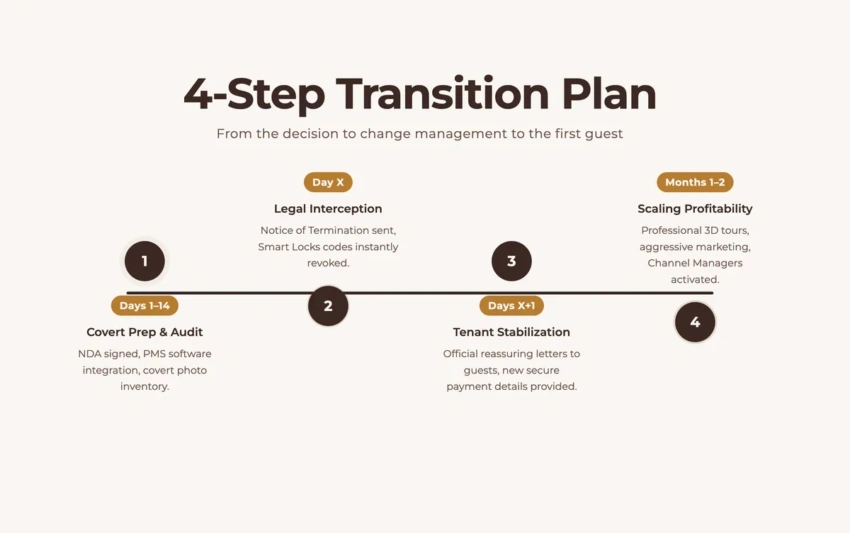
A clear 4-step roadmap guarantees a seamless transition from decision to the first guest
The 6 Biggest Fears of Owners When
Switching Property Management Companies
Now that you have the roadmap, you should still have concerns. And that’s completely normal. The fear of implementing this plan often stems from a set of common, systemic fears about retaliation from the old manager.
The real danger is usually not the transition itself, but waiting too long to make it. If the current management is already creating problems — fewer bookings, poor communication, unclear reporting, neglected maintenance, or a gradual loss of control over the property — those issues rarely resolve on their own. More often, they grow into bigger financial and operational problems that become harder and more expensive to fix.
Before we dive into the specific fears, it is important to state a statistical reality. While the following sections analyze the maximum possible risks to ensure you are fully protected, in practice, over 85% of management transitions happen smoothly and amicably.
With a professional new agency guiding the process, most technical issues – such as calendar syncing, access adjustments, or account handovers – are resolved through standard negotiations without any conflict. The strict protocols described below are simply your “insurance policy” to guarantee a 100% safe process.
Remember, inaction in a situation where your current management is ineffective will result in far greater problems – plunging occupancy, ruined reputation, and massive financial loss – than addressing these manageable transition fears.
Fear 1. “What if the old management company finds out ahead of time?”
The most powerful psychological barrier at the initial stage is the fear of information leakage. Clients who initiate a search for a new agent invariably make the same demand: total secrecy. There is a deep and well-founded fear that the current management will learn of the impending contract termination before the owner is ready.
This phenomenon is classified as ‘moral hazard’. Information asymmetry works against the property owner: as soon as the manager realizes that their services will soon no longer be required, their motivation to provide high-quality maintenance to the property plummets. In real-life cases, agents have intentionally delayed processing tenant repair requests, stopped responding to guest inquiries.
Legal and digital tools for information security
Our experience shows that switching property management companies should be kept strictly confidential during the initial audit stage. And we have to say that leading agencies in the industry always guarantee absolute confidentiality during preliminary consultations, eliminating any possibility of information leakage to third parties or current management.
- Non-disclosure agreements (NDAs). Security standards begin with the mandatory signing of a confidentiality agreement at the very first contact. A strict NDA ensures that the owner’s request, the property’s location, and its financial performance remain confidential. It also explicitly prohibits the new potential agent from contacting maintenance staff, concierge services, or homeowners’ associations until receiving express written instructions.
- Out-of-band communication channels. Owners are strictly advised against using corporate domains, email services, or messaging apps that are in any way administered by the current management company. To ensure safe discussion of the transition details, alternative, completely isolated communication channels are being created.
The “cover story” (legend) strategy for requests
The complexity of the transition lies in the fact that to value the property, the new management company in some rare cases requires historical data: utility bills, expense reports, and so on. If the owner suddenly requests all this documentation from the current manager, it will immediately raise suspicions.
Management practice demonstrates the effectiveness of the “legend” strategy. Requests for financial documentation are submitted under the guise of other legitimate business processes. The most reliable pretexts include:
- A planned comprehensive audit to prepare annual tax reporting.
- Preparing a financial portfolio for asset transfer to a family trust or holding company (LLC).
- Asset valuation at the request of an insurance company.
Such legends allow for the collection of a comprehensive database without disrupting the status quo or provoking conflicts.
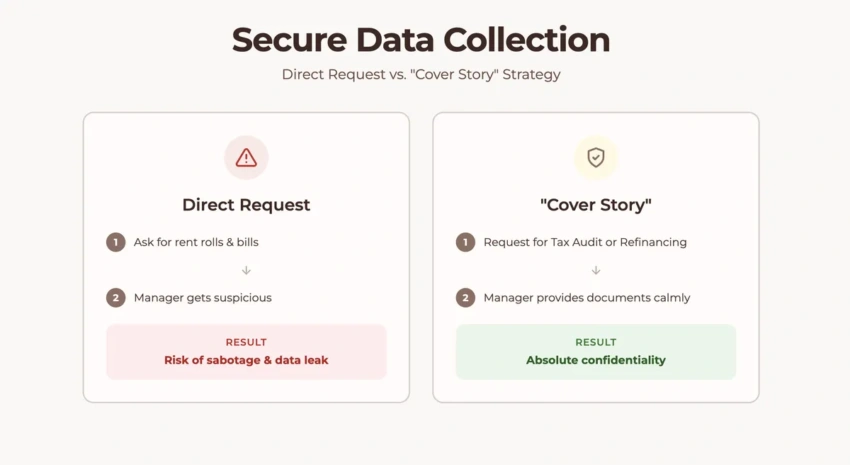
Avoid direct data requests to prevent sabotage and data leaks from your current manager
Digital footprint protection and leaks prevention
During the preliminary assessment, we strongly advise property owners against creating “test” or duplicate listings on platforms (Airbnb, Vrbo, Booking.com). While some market players do attempt to run multiple profiles for the same property to capture more traffic, doing this during a management switch may pose some operational risks.
The primary threat is human rather than algorithmic: the current management company’s staff regularly monitor local search results and competitor pricing. A newly published listing with familiar photos will instantly blow your “legend.” Likewise, identical competing listings cannibalize each other’s SEO ranking and confuse potential guests. It’s all about information security.
Fear 2. “What will happen to future holiday bookings?”
For short-term rental properties, the thought of switching to new property management companies triggers an acute fear of losing already confirmed bookings. Property owners worry that reservations for peak periods, such as Christmas and New Year holidays, might be canceled by the current manager out of retaliation or lost due to technical limitations, leading to colossal financial losses.
2026 platform policies: technical barriers of account migration
A deep analysis of user agreements and operational updates from aggregators for 2026 demonstrates an uncompromising stance regarding the transfer of listing ownership.
- Airbnb’s policy prohibits the direct transfer of listings from one account (the old manager) to another (the new operator or owner), even with official property sale documents. Similarly, under the Circumvention Policy, they may block new profiles as duplicates if they simply copy photos and texts from an old listing without any differences or if they break the platform’s rules.
- Vrbo also does not allow direct listing transfers. If the management company changes, the old listing must be closed and a new one created from scratch. However, Vrbo provides an official mechanism for transferring historical reviews. The new owner or manager has the right to submit a support request, and after verification, reviews will be moved to the new profile with a note that they were received under previous management.
The “Co-hosting bridge” strategy
To avoid losing future bookings, industry experts employ a soft digital migration strategy known as the “co-hosting bridge.” The optimal, though rare, scenario is when the primary listing was originally created using the owner’s personal phone number and email, with the management company only added as a Co-host with full access. In this case, the transition is as simple as removing the old team’s access rights and adding the new one.
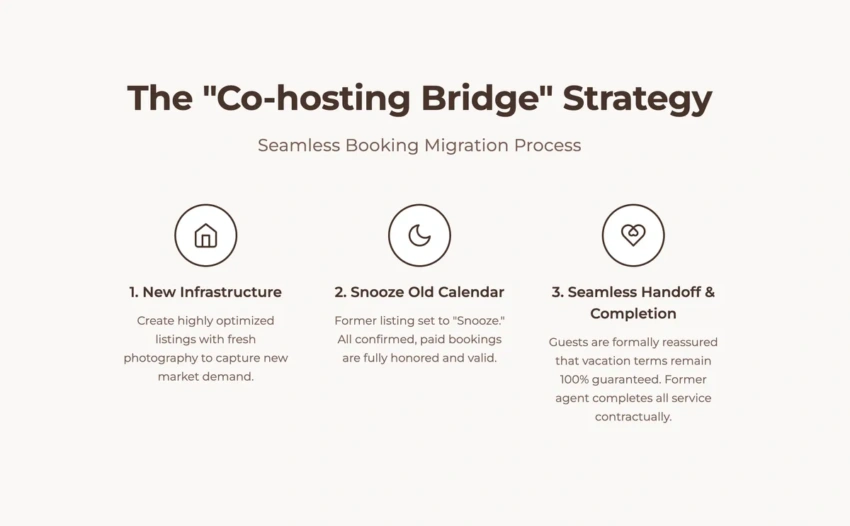
The “Co-hosting Bridge” strategy ensures a stress-free transition and 100% security for all future guest reservations
However, in 90% of cases, the account belongs entirely to the old management company. In this scenario, a standard, conflict-free transition protocol is applied to ensure zero stress for the owner and a seamless experience for the guests:
5-step conflict-free transition plan
| Step | Action & Strategy |
|---|---|
| 1. New infrastructure setup | The new management company creates a highly optimized listing from scratch with fresh photos, preparing it to capture new market demand. |
| 2. Calendar stabilization | The previous listing is simply set to “Snooze” for new inquiries. All already paid, historical bookings remain completely safe, active, and valid in the system. |
| 3. Transition agreement | A standard handover document is signed. The former management company is contractually obligated to flawlessly service all existing reservations until their final guest checks out. |
| 4. Guest reassurance | Guests with upcoming stays receive a polite, official notification about the property’s management upgrade, assuring them that their vacation, comfort, and booking terms are 100% guaranteed. |
| 5. Seamless completion | In the vast majority of cases, guests simply arrive and enjoy their stay under the original booking without any extra steps. The new management quietly takes over full operations only after these historical bookings are completed. |
It is worth remembering that the temporary inconvenience of creating a new listing, rebuilding visibility, or collecting fresh reviews is not comparable to the long-term damage caused by ineffective management. If the current situation is already hurting bookings, guest experience, or the property’s reputation, waiting only makes the recovery harder. The longer the problem continues, the more difficult it becomes to regain lost rankings, restore trust, and return the property to stable performance.
Fear 3. “Will we lose all reviews and drop in search rankings?”
Starting a business “from scratch” with a zero rating sounds like a death sentence to an owner. The loss of hundreds of positive reviews accumulated over years triggers a well-founded fear that the new listing will end up on the last pages of search results. However, a deep understanding of modern search algorithms allows this fear to be turned into a powerful competitive advantage.
Deconstructing 2026 Airbnb and Vrbo ranking algorithms
To quickly secure top positions for a new listing, it is essential to understand how aggregators evaluate properties in 2026. Massive algorithm updates have shifted the model from “interest” to “trust.”
- Conversion priority (search-to-book rate). Platforms now track the entire customer journey via Full-Funnel Analysis. Listings that successfully convert views into actual reservations receive the highest priority.
- Recency factor. For search robots, fresh reviews carry exponentially more weight than a historical rating from three years ago. The algorithm evaluates current service quality, not past achievements.
- Guest favorites status. On Airbnb, the “Guest Favorites” badge has become a key ranking factor, displacing the traditional Superhost status. This badge is awarded for consistent 5-star service, low cancellation rates, and excellent cleanliness.
Usage of the “New listing boost” algorithm
While Airbnb reviews do not transfer, publishing a new profile activates the “New Listing Boost” mechanism. For the first 2-4 weeks, new objects receive a powerful boost in search results visibility.
Professional teams leverage this temporary window of opportunity with a precise strategy:
- Strategic introductory pricing. During the first few weeks of the new listing, a dynamic pricing strategy is carefully applied, often setting rates slightly below market competitors to guarantee immediate traction.
- Potential conversion surge. The platform’s visibility boost, combined with attractive introductory pricing, can quickly fill the calendar with early bookings. A strong search-to-book conversion rate may send a positive signal to the platform’s search algorithms.
- Generating a new foundation. The bookings secured during this initial phase lay the crucial groundwork for your new reputation. Even securing just 2 or 3 perfect 5-star reviews from these early guests provides enough solid “social proof” to form a reliable rating foundation. This early momentum keeps the property highly visible organically, allowing the new management to gradually restore prices to premium market levels over the following months.

Strategic initial pricing activates platform algorithms for a powerful search ranking boost
Visual social proof and content
The loss of text reviews is compensated for using visual engineering. The most vivid and detailed positive reviews from the old profile are saved as high-quality screenshots and uploaded to the new listing’s photo gallery with a clear graphic label: “Reviews from our past guests.”
A management change is the perfect time for a radical content update. We’ve observed that a high-quality gallery (18 to 25 photos), created with careful composition, balanced natural light, and photographing facades during the “golden hour,” increases ad click-through rates (CTR) by 30-40%.
Fear 4. “They will break the locks and take the decor!”
Many property owners have an emotional fear that a dismissed management company might maliciously damage the property or take expensive decor. However, in reality, intentional sabotage or theft is exceptionally rare. The actual risks during a transition are much more mundane: a frustrated former agent might act unprofessionally by simply leaving the front door unlocked after their final check, failing to return mechanical keys, or misplacing minor household items.
Standard inventory protocol (condition report)
While malicious damage is highly unlikely, professional transitions still require a strict protocol to prevent any “misunderstandings” or lost items due to negligence. A standard industry best practice is to conduct a thorough condition report just before the official handover.
- Legitimate pretext. Owners are advised to conduct an unscheduled inspection under a plausible guise, such as an annual insurance appraisal or a routine HVAC maintenance check.
- Evidence collection. A standardized Condition Report is created, including high-quality photos. This covers everything from the serial numbers of electronics to the general state of the furniture.
- Digital authenticity. All documentation must have immutable timestamps and EXIF data. This provides a clear, undeniable baseline of the property’s state, eliminating any future disputes over missing items or property condition during the handover.
Economics and security of smart locks
| Expense item / function | Traditional mechanical locks | Electronic smart locks |
|---|---|---|
| Avg. equipment & install cost | $40-$120 | $150-$450+ |
| Costs for rotation (new tenant / PMC) | $75-$150 per locksmith call | $0 (remote digital code management) |
| Response to PMC dismissal | Requires physical presence and emergency locksmith. Risk of entry via old duplicates. | Instant revocation of all digital master codes in one click from anywhere in the world. |
| Activity monitoring | Impossible to track. | Real-time Audit Trail showing whose personal code was used for entry. |

Smart locks eliminate the risk of unauthorized access from former staff and contractors
Fear 5. “We will be dragged through the courts and issued huge fines”
The fear of lawsuits, penalties, and complicated legal procedures often makes owners hesitate before changing property management companies. In reality, most transitions do not lead to serious legal problems, especially when the process is handled carefully and the owner understands the terms of the existing agreement.
Legislation and contract requirements can vary significantly depending on the jurisdiction, so the first step is to review the signed agreement with the current property management company and understand the notice period, termination conditions, payment obligations, and any possible restrictions.
In many cases, however, the contract itself does not create a major obstacle. Sometimes there is no formal written agreement at all, or the termination terms are simple and manageable. As a result, in most practical situations, this part of the transition is resolved without major complications when the process is structured and legally correct.
Fear 6. “The manager will start stealing money before leaving”
Even with strong evidence of financial impropriety by the current operator, property owners are often afraid to start the dismissal process. There is a persistent fear that during the “notice period” (from the moment the notification is served to the actual handover), an unscrupulous manager will aggressively withdraw funds from escrow accounts, generate fictitious completion certificates, or simply misappropriate tenant security deposits.
While the fear of blatant theft is common, outright theft of escrow funds or deposits is illegal and relatively rare, as it carries the immediate risk of legal prosecution. The actual risk during the “notice period” is much more subtle. A frustrated manager might try to “nickel-and-dime” the owner by inflating final invoices, adding “administrative transition fees,” or suddenly discovering the need for expensive, unverified maintenance right before their contract ends.
Signs of unethical management (skimming)
Financial abuses by managers take sophisticated forms. Financial auditors highlight key “red flags” indicating fraud before the process of switching property management companies even begins:
- Rent skimming. The illegal withholding of part of the collected revenue. The most obvious sign is when the manager insists that tenants pay exclusively in cash or through non-transparent personal crypto wallets. In short-term rentals, managers may rent out the property “off the books,” artificially deflating occupancy rates in reports.
- Late fee manipulation. A sudden and unexplained rise in late fees charged to reliable tenants with perfect histories. This is a signal that the manager is intentionally delaying the posting of funds to transit accounts to create artificial delinquencies and legally keep the penalties.
- Phantom invoices. Issuing bills from affiliated or non-existent companies for cosmetic repairs, painting, or HVAC maintenance that were never actually performed.
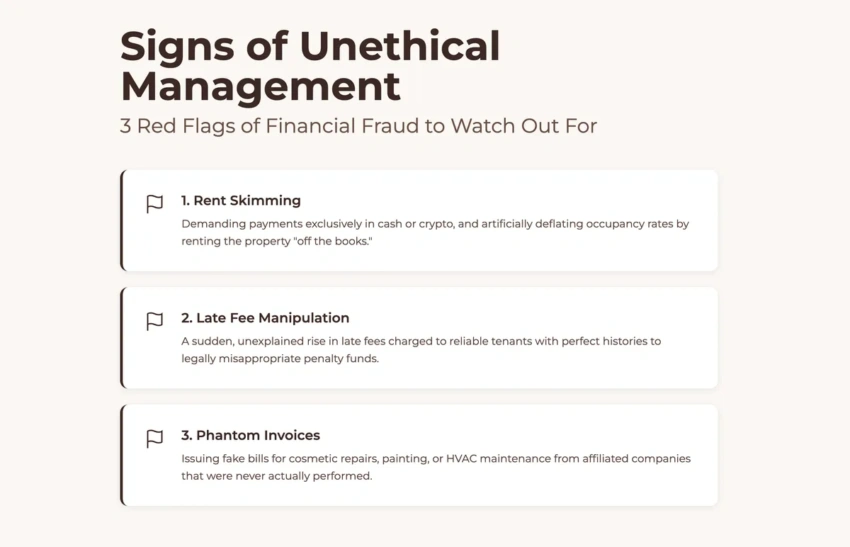
Watch out for rent skimming, late fee manipulation, and phantom invoices
Financial audit and platform reports
To prevent the withdrawal of funds and build an evidentiary base, the owner must initiate a deep reconciliation. We forbid reliance on manually generated reports in Excel by the manager. The owner must demand direct, uneditable exports of payout reports directly from the dashboards of aggregator platforms (Airbnb, Vrbo) or bank statements.
Any discrepancy between the actual platform receipts and the PMC’s reported figures gives the property owner an undeniable legal right to terminate the contract “for cause” immediately. This not only eliminates any early termination penalties but also serves as leverage for the safe return of all held deposits.
The Real Cost of Delaying Switching
Property Management Companies
Once all transition fears are addressed, owners face a much harsher reality: the cost of inaction. In the luxury short-term rental market, delaying a management change doesn’t just result in minor accounting errors. The true losses are far more catastrophic and rarely have anything to do with general market fluctuations.
Owners are pushed to change their management not because of revenue leakage, but because of complete operational failures. The real triggers are plunging occupancy rates, communication black holes where the agent ignores messages for days, ruined property reputations due to neglected maintenance, and completely empty calendars during peak holiday seasons. When a property manager stops caring, a high-yield villa can lose tens of thousands of dollars in just a few months.
The anatomy of operational losses
To make an informed decision about switching property management companies, an owner needs a clear understanding of where the real money is being lost. The financial drain rarely comes from minor accounting errors; it is a compounding disaster of missed booking opportunities, poor guest communication, and opaque billing practices.
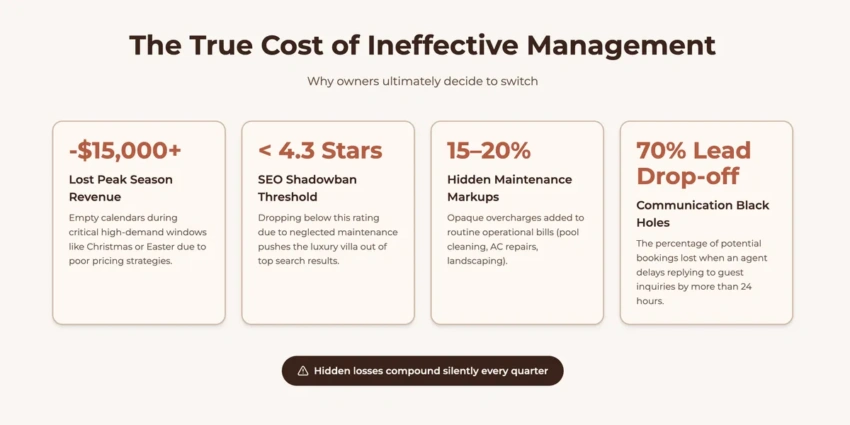
The true cost of ineffective management: from plunging occupancy and lost revenue to severe SEO drops
Main sources and mechanisms of revenue leakage
| Revenue leakage category | The mechanism of loss occurrence | Financial influence |
|---|---|---|
| Missed and underpaid fees | Failing to track and charge guests for electricity overages (a standard practice in the DR), missing platform payouts, or forgetting to invoice for extra concierge services (e.g., golf carts, private chefs). | A consistent “silent” loss of up to 5-7% of total monthly revenue. |
| Vacancy loss | Slow response times to guest inquiries on Airbnb/Vrbo, outdated pricing strategies that miss high-season peaks, and poor overall listing visibility. | Every missed weekend booking during the high season can cost the owner anywhere from $1,000 to $3,000+. |
| Operational and system errors | Double bookings due to unsynced platform calendars, or missed housekeeping schedules resulting in guest refunds and negative reviews. | The average cost of compensating a frustrated guest or resolving a double-booking crisis can easily exceed $1,000 per incident. |
| Opaque maintenance & billing | Inflated invoices for routine villa maintenance (pool cleaning, AC repair, landscaping) and a lack of transparent, itemized expense reports from the manager. | Owners can overpay by 15% to 20% on their monthly operational expenses without ever realizing it. |
To mitigate these risks and ensure a safe transition, professional property managers follow a strict, conflict-free handover protocol. In the luxury real estate market, this means implementing absolute confidentiality during the audit stage, ensuring the legal integrity of the transition, and using advanced Property Management Systems (PMS) to prevent any double bookings.
Conclusions
The fears that paralyze property owners before switching property management companies are absolutely natural. The fear of commercial secret leakage, the loss of profitable New Year’s bookings, material vandalism, hidden multi-thousand-dollar fines, and the loss of digital SEO reputation creates a false sense of hopelessness.
However, a detailed analysis of the mechanics of the modern real estate market proves that each of these fears has a reliable systemic antidote. Implementing NDAs, using smart electronic locks, applying the “Co-hosting bridge” tactic for seamless booking migration, and conducting strict payout audits deprive unscrupulous contractors of any manipulation levers.
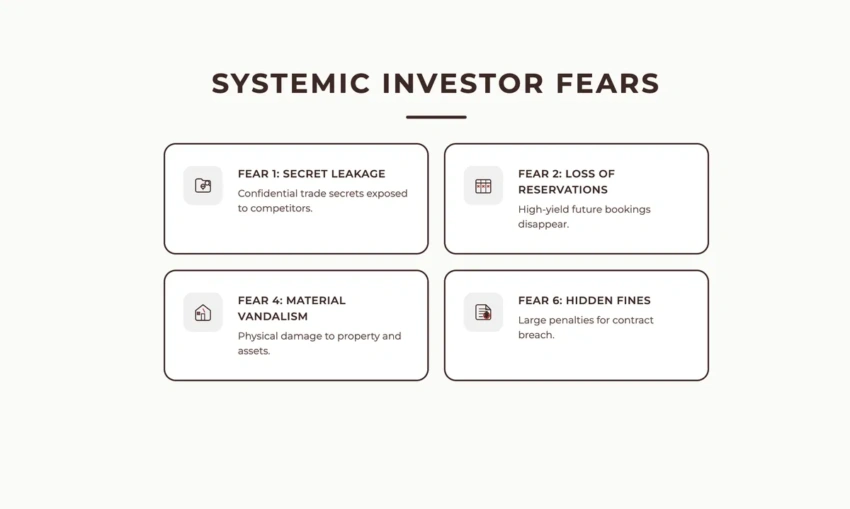
Systemic fears paralyze property owners, but systemic antidotes provide a secure transition path
With the right approach, changing property management becomes a strategic upgrade rather than a stressful ordeal. And it is worth remembering: avoiding the decision is usually far more expensive than the manageable risks described above.
If your current management is already causing problems — declining bookings, poor communication, unclear reporting, neglected maintenance, or loss of control over the property — these issues will not disappear on their own. They need to be addressed before they turn into deeper financial and operational losses.
If you own a property in the Dominican Republic, our expert team is ready to organize a smooth, secure transition and help maximize your passive income.
Learn About Our Management Approach
FAQ on Switching
Property Management Companies
Can you change a management company?
Yes, this is a standard and necessary procedure if you’re dissatisfied with the quality of services or are losing money. Changing your management company isn’t a chaotic process, but a rigorous operation consisting of four critical steps.
With the right step-by-step approach, this process becomes a powerful strategic tool for increasing your asset’s competitiveness and maximizing passive income.
How do I get out of a management contract?
The termination process depends on the terms of your contract and local laws:
- Review the terms. Check the required notice periods (for example, in the US and Canada, it’s typically 30 to 90 days) and any penalties for early termination.
- Exploit reporting discrepancies. Request data downloads directly from booking platforms. Any discrepancy between the manager’s reports and actual revenue gives you the legal right to terminate the contract “for cause” and avoid hefty penalties.
- Send a formal letter. Notice of termination must be sent in strict accordance with local laws (by certified mail with return receipt requested, via Burofax, etc.).
How do I resign from a management company?
To avoid retaliation, sabotage, and data loss, the dismissal should be sudden for the old company. Follow this algorithm:
- Collect data discreetly. Request copies of leases, insurance policies, and deposit balances under a legitimate pretext (e.g., for a tax audit or refinancing).
- Prepare a digital database. Create new profiles on booking platforms and configure software (PMS) in advance.
- Legal interception. Send an official notice of termination.
- Lock access. Immediately change all passwords on smart locks remotely and revoke any powers of attorney issued to ensure the old team loses physical access to the property.
How much notice does the landlord have to give a tenant to move out?
When changing management companies, tenants do not need to be evicted, and existing reservations are not canceled.
- All existing leases remain fully valid.
- The main task at this stage is “tenant stabilization.” The new agency simply sends residents formal, courteous letters.
- These letters confirm that their living conditions, rent, and security deposits remain unchanged. Tenants are simply provided with new secure payment details and new 24/7 support contact information.
What are red flags in a manager?
There are three main red flags that indicate a manager may be deceiving you:
- Rent skimming. The manager insists that tenants pay exclusively in cash or transfer funds to personal crypto wallets. This is also known as renting the property “off the books,” which artificially lowers occupancy rates in reports.
- Late fee manipulation. A sudden and unexplained increase in late fees for otherwise reliable tenants with a perfect history (the manager delays the payment of funds to legally pocket the late fees).
- Phantom invoices. Regular invoices from affiliated (or non-existent) companies for minor repairs or air conditioning maintenance that were never actually performed.
What are common agent red flags?
There are three major red flags indicating potential financial fraud or unethical behavior by a management company:
- Rent skimming. The manager demands payments exclusively in cash or cryptocurrency, or they rent out the property “off the books” to artificially deflate occupancy rates.
- Late fee manipulation. There is a sudden, unexplained increase in late fees charged to reliable tenants with perfect payment histories, allowing the manager to legally keep the penalty funds.
- Phantom invoices. The manager issues fake bills from affiliated or non-existent companies for cosmetic repairs or maintenance that were never actually performed.
Can you remove a management company?
Yes, you can remove a management company, but the process must be handled as a strict, surgical operation to avoid sabotage or revenue loss. A safe transition involves covertly gathering data and preparing new digital infrastructure, officially sending a Notice of Termination, simultaneously revoking their physical access via smart locks, and directly stabilizing the tenants to ensure operations continue smoothly.
Who is the biggest property management company in the world?
The answer depends on the specific real estate sector:
- Associa is widely recognized as the largest property management company in the world specifically for Homeowner Associations (HOAs).
- CBRE is the largest and most dominant property management company globally in the commercial real estate sector.
- Property Management Inc. (PMI) is one of the largest worldwide in terms of franchise networks for residential and commercial management.
What are the top 5 property management companies?
While global rankings fluctuate based on the specific asset class (commercial vs. residential), the top 5 largest and most influential property management companies typically include:
- CBRE (Global leader in commercial real estate)
- Greystar Real Estate Partners (The largest residential apartment operator)
- Jones Lang LaSalle (JLL) (Global leader in commercial property and investment management)
- Cushman & Wakefield (Major global commercial real estate services firm)
- Associa (The global leader in community and HOA management)
How much is the salary of a property manager in the USA?
As of April 2026, the average base salary for a property manager in the United States is approximately $65,454 per year. Depending on location, portfolio size, and experience, salaries typically range from $42,900 to nearly $100,000 per year, with major hubs like Sacramento, CA, and Denver, CO, offering higher average compensation.
Who are the Big 4 in real estate?
In the commercial real estate and facility management industry, the global “Big Four” firms are:
Updated on: . Author: