
The Owner’s Guide to Property Management in the Dominican Republic – How to Delegate Without Losing Control in 2026
Many property owners in the Dominican Republic make a fundamental mistake: they conflate “delegation” to the management with “loss of control.” Trying to completely free themselves from day-to-day operations, owners often hand over absolute control of their property, funds, and digital assets to third-party property management companies. Thus, instead of reaping the benefits, the owner risks becoming completely dependent on third-party accounts, bank accounts, unclear processes, and local contractors.
Secure vacation rental management guide for property owners in the DR
Based on our experience managing property in the Dominican Republic, we can say that a professional property management company is your greatest ally, not a threat. This article is not intended to instill fear; our goal is to share friendly, tried-and-true advice for building relationships with partners so you always remain the full owner of your business. In this guide, we’ll walk you through every step of the process to ensure the safe and transparent management of your villa or apartment.
Pre-Contract Checklist: Legal and Tax Audit in the DR
The foundation for independence is laid during the planning stage. Before handing over the keys to their property to a third party, the owner should conduct a thorough audit of their assets, understand their legal rights, and determine the structure of the future partnership.
ROI maximization with CONFOTUR tax exemptions
Dominican legislation has specific characteristics that dictate the rules of the game in the real estate market. According to the Civil Code of the DR, all matters concerning real estate within the country are governed exclusively by local law, regardless of whether the owner is a Dominican citizen or a foreigner.
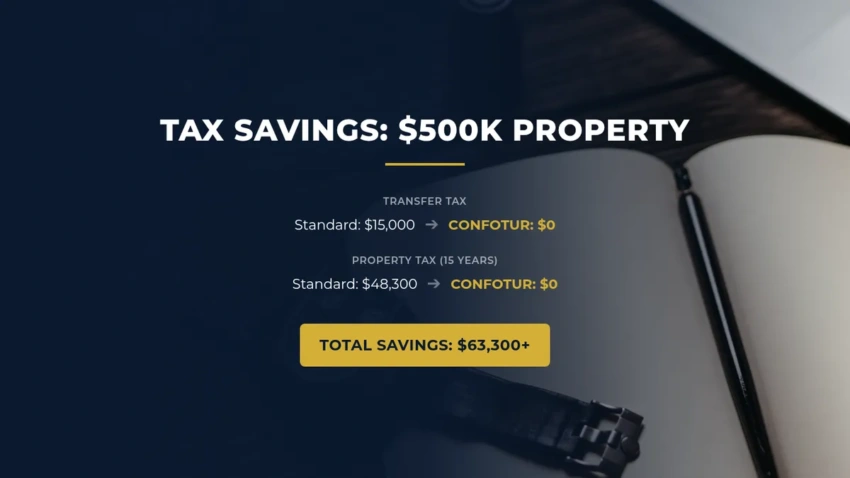
Save over $63,300 in real estate taxes with CONFOTUR benefits
In our experience, the first step toward protecting your interests is to gain a thorough understanding of the tax incentives applicable to your property. One of the main drivers of the Dominican Republic’s investment appeal is Law 158-01, better known as CONFOTUR. This government initiative is created to boost tourism and offers buyers of real estate in certified projects (particularly relevant for Punta Cana, Bávaro, and Cap Cana) significant tax incentives.
Dominican Republic real estate taxes:
standard rates vs. CONFOTUR benefits
| Tax type | Standard rate in the DR | Benefit under CONFOTUR | Potential savings (based on a $500,000 property) |
|---|---|---|---|
| Transfer Tax | 3% of the estimated value of the property | Full exemption (one-time per purchase) | $15,000 savings at closing the deal |
| Annual Property Tax (IPI) | 1% on amounts exceeding ~$178,000 USD | Full tax exemption for up to 15 years | About $3,220 annually, which is $48,300 over 15 years |
| Rental Income Tax | 20-27% of net rental income | Tax exemption for up to 15 years | Thousands of dollars annually, depending on operating profit |
Furthermore, our experience shows that incompetent managers often mistakenly include tax payments—like income tax or IPI—in financial statements, even when your property qualifies for full exemptions. The owner must inform the property manager in advance that they hold a CONFOTUR certificate and insist on transparent accounting practices.
HOA bylaws and short-term rental description
The second most important aspect of preparation is reviewing your Homeowners Association (HOA) bylaws and local laws. In the DR, there is no national ban on using platforms like Airbnb for short-term rentals. However, this does not mean you can rent out your property on a daily basis just anywhere.
The rules are set by the specific condominium. Some residential complexes fully encourage short-term rentals, others strictly regulate them (by imposing registration fees or guest access rules), and still others prohibit them entirely, allowing only long-term rentals.
- Zoning and competition. Bavaro, El Cortecito, and Cocotal are seeing the highest demand for rentals thanks to their walking distance to beaches and well-developed infrastructure. At the same time, exclusive areas like Cap Cana offer higher rental rates, but profitability there may be squeezed by high HOA fees and the cost of the property itself.
- Long-term leases and Law 85-25. If you (or your property management company acting on your behalf) decide to enter into a long-term lease, you must take into account the recently enacted Law 85-25. This law limits the security deposit to two months’ rent and sets a cap on annual rent increases at 10%.
Based on our experience managing properties in the DR, we recommend that owners review the HOA rules themselves to ensure that the management company does not involve you in a legal dispute with neighbors or the complex’s administration, which could result in fines and restricted access for your guests.
Choosing the right Dominican Republic property management model
To avoid becoming a hostage to the situation, it is important to understand that handing over property management is not a binary choice (“hand over the keys and forget about it” or “do everything yourself”). The hospitality industry offers flexible options.
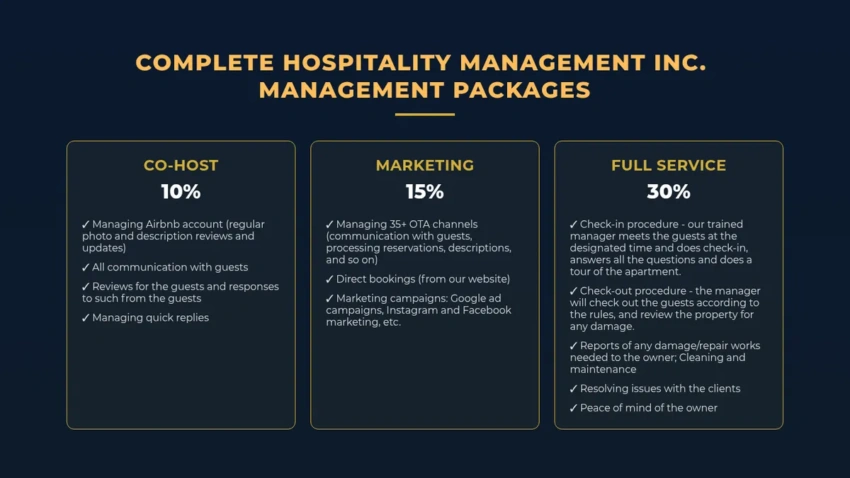
Complete Hospitality Management packages table for short-term rentals
At Complete Hospitality Management (CHM), we have developed a transparent package structure that allows owners to choose a level of involvement that suits them, with fees charged solely as a percentage of revenue generated (the “you earn = we earn” model).
- Airbnb co-host package (10% of revenue). Ideal for hosts who want to retain maximum control. Includes managing the Airbnb account, communicating with guests, writing reviews, and setting up automated replies. The host can coordinate cleaning and maintenance directly with local contractors.
- Marketing and OTA channels (15% of revenue). Expanding reach. Includes managing bookings across 35+ platforms (OTAs), direct bookings, and digital marketing (Google, Instagram, Facebook Ads).
- Marketing + check-in/check-out (20% of revenue). Includes the physical presence of a manager during guest check-in and check-out, as well as conducting an inspection of the property for damage.
- Full management (30% of revenue). Includes all of the above, as well as housekeeping, maintenance, and 24/7 guest support (for luxury villas with a pool valued at $800,000 or more, the rate may be reduced to 20%).
Choose the right model before you begin working together. This way, you’ll delegate only those processes that truly take up your time and retain strategic control over the asset.
How to Avoid Handing Over Complete Control to a Third Party
The golden rule of safe property ownership: whoever controls the keys and the power switches controls the business itself. Delegating operational activities should in no way imply relinquishing rights to physical access points and critical resources at your property.
Energy independence and the specifics of working with CEPM
One of the features of the infrastructure in Punta Cana, Bavaro, and the surrounding areas is the monopoly electricity supply system operated by CEPM (Consorcio Energético Punta Cana Macao). Prepaid meters are widely used here.
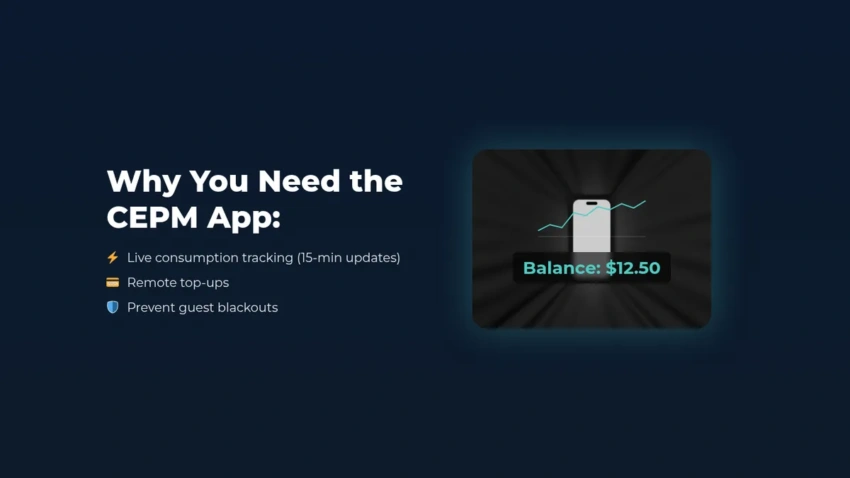
Real-time consumption tracking to prevent guest blackouts in Punta Cana
However, the way CEPM works brings operational risks; specifically, when your prepaid kilowatt-hour balance runs out, the utility provider immediately cuts off the power supply. In the DR’s tropical climate, ACs run almost around the clock, making electricity the largest operating expense for Airbnb listings.
If a management company has sole control over your CEPM account, it gains significant leverage. In the event of disputes, payment delays, or the manager’s negligence, the account balance may not be replenished on time. A power outage while guests are staying is a disaster for the property’s rating, leading to refunds and bad reviews.
How to maintain control over CEPM:
- Direct access via the mobile app. The account holder must install the official CEPM app on their smartphone. The app allows you to monitor your electricity usage in real time (meter readings are updated every 15 minutes) and check your current balance.
- Independent payment. You can top up your balance remotely. However, users have noted that the CEPM app sometimes has issues processing foreign bank cards due to verification difficulties and unpredictable exchange rates (transactions are processed in Dominican pesos).
- Automation through local banks. Therefore, in our experience, the most reliable solution requires you to register your property in a Dominican bank’s online banking system (such as Banco Popular’s Virtual Office) and set up automatic payments. You can also use services like Hablax to pay bills remotely.
- Expense audit. Direct access to CEPM statistics allows property owners to verify the management company’s financial reports. If the monthly report lists $400 for electricity, you can always open the app and compare that figure with actual consumption.
Physical access with smart locks as a security tool
The second critical element of control is physical access to the property. The use of traditional keys in the rental business is an outdated practice that creates significant vulnerabilities. When guests, cleaning services, or the property management company change, you’ll have to physically replace the lock cylinders, which results in a waste of time and money.
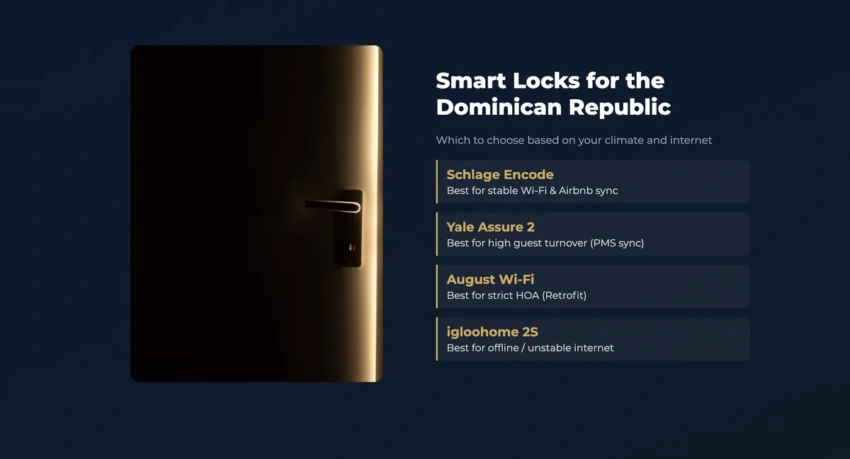
Choose the best smart lock based on climate and internet stability
As experts in Dominican Republic property management, we strongly recommend smart locks. These devices allow you to generate unique digital PIN codes for each guest and employee, as well as track door access history in real time. Over 89% of modern travelers prefer contactless check-in (self-check-in), so this not only enhances security but also increases booking conversion rates.
When selecting a smart lock for the Dominican Republic market, it is important to consider the local power grid and internet connection quality, which can be unreliable during hurricane season.
4 top smart locks for vacation rentals in the DR
| Smart lock model | Connection and operation features | Battery life | Optimal use in the Dominican Republic |
|---|---|---|---|
| Schlage Encode Plus | Built-in Wi-Fi, direct integration with Airbnb | More than 12 months | The best choice for properties with reliable internet access. Highest levels of security and build quality. |
| Yale Assure Lock 2 | Wi-Fi and Bluetooth modules | More than 12 months | A leader in property management system (PMS) integration. Highly reliable even with high guest turnover. |
| August Wi-Fi Smart Lock | Installs over existing deadbolt (Retrofit) | 6-8 months | Essential for condos with strict HOA rules that prohibit altering the appearance of doors. |
| igloohome Smart Deadbolt 2S | Works offline (code generation using a time synchronization algorithm, without Wi-Fi) | 12 months | An ideal solution for remote villas and areas of Bávaro with unstable internet. The codes will work even if the router is disconnected. |
The property owner must be the sole Master Admin in the lock’s mobile app. Representatives of the management company, cleaners, or maintenance staff are granted only “Manager” or “Temporary User” status. If you leave the company, you can revoke their digital access with a single click. No need to replace locks, no risk of unauthorized entry.
Digital and Financial Autonomy for Property Owners
To be sure that your property remains a truly independent and liquid business asset, you must build your own ecosystem around it, with elements that are not owned by your management company.
Airbnb listing security via the co-hosting model
One of the most costly mistakes owners make is transferring the right to create a listing (property profile) to a management company via its corporate account.
In the traditional property management model, the company creates a listing for your property under its own profile. All intellectual value – guest reviews, Superhost status, booking history, and a high ranking in search results – is accumulated in the manager’s account.
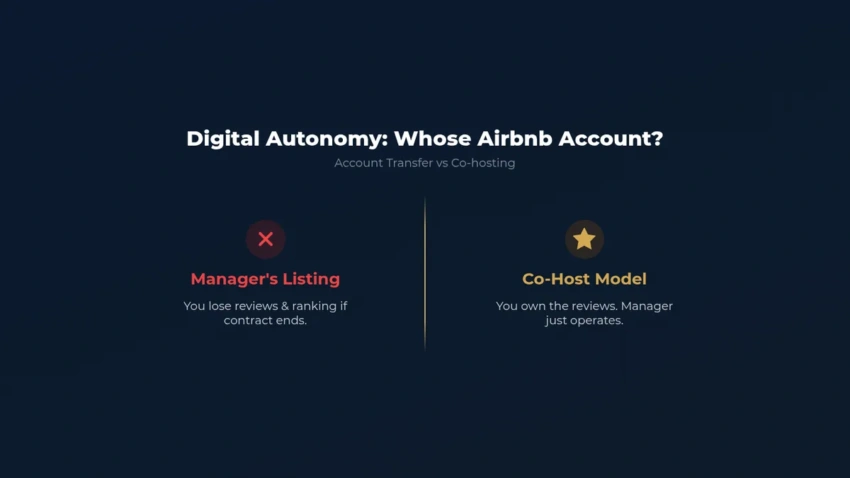
Keep full ownership of your reviews and Superhost ranking with co-hosting
If you decide to terminate the contract, the listing will be deleted. You’ll have to create a new Airbnb profile with zero reviews. As a result, in the highly competitive Punta Cana market, where there are approximately 4,900 active listings, a property without reviews becomes virtually invisible, and it will take you months of price-cutting to regain your footing.
The solution is the Co-hosting Model
Therefore, to maintain digital sovereignty, you must use the co-hosting feature built into Airbnb.
- You (the owner) create a listing on Airbnb using your personal account.
- You complete identity verification and enter your tax information.
- You send an official invitation to the management company (e.g., Complete Hospitality Management) to become a Co-host for your property.
- The Co-host is granted the necessary permissions: editing the calendar, changing prices, communicating with guests, resolving disputes, and updating photos.
- Important! Under this arrangement, all reviews, ratings, and ownership of the digital storefront remain exclusively yours.
Remember that you can revoke a co-host’s access at any time while retaining all future bookings and the reputation you’ve built over the years.
Local bank accounts for direct revenue flows
In the Dominican Republic, property management and reliance on external cash flows are significant risk factors. A system in which the company receives all funds from booking platforms into its own accounts, accumulates them, and then transfers the net profit to the owner at the end of the month creates a risk of a cash flow gap.
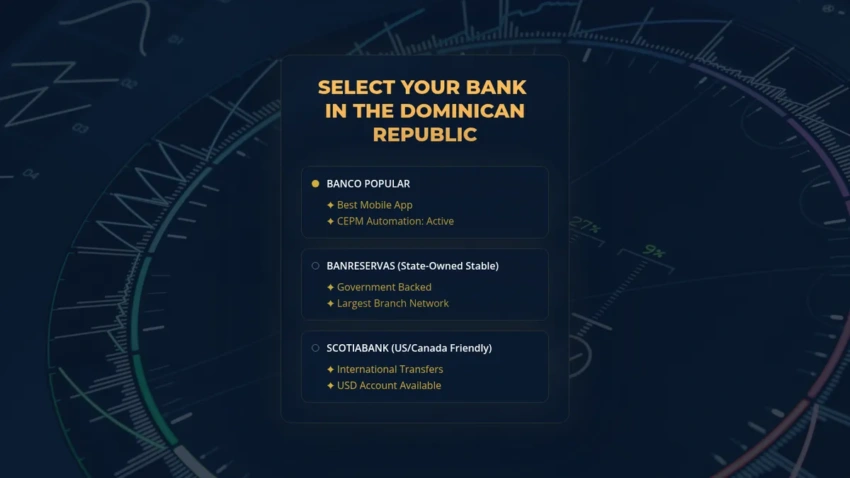
Choose between Banco Popular, Banreservas, and Scotiabank for direct rental income
Based on our experience, we strongly recommend that property owners open a personal bank account in the Dominican Republic to ensure their financial security. Foreigners (non-residents) are fully entitled to open accounts at local banks.
Best banks in the DR for expats and property owners
| Bank in the DR | Attractiveness to foreigners | Key benefits |
|---|---|---|
| Banco Popular | Very high | The largest private bank. The most extensive ATM network. An excellent mobile app. Perfect for setting up automatic payments for CEPM services and international money transfers. |
| Banreservas | High | State-owned bank (the largest in terms of assets). It offers the highest level of stability, but customer service can sometimes be more bureaucratic. |
| Scotiabank | Very high | A Canadian bank that is deeply integrated into the North American financial system. It offers the utmost convenience for U.S. and Canadian citizens thanks to familiar standards. |
To open an account as a non-resident, you will typically need a valid passport, a second form of photo ID (such as a driver’s license), documents confirming the legal source of your funds (a tax return from your country of residence), and a letter of recommendation from your home bank. Having a local account in DOP and USD will allow you to pay taxes, utilities, and local contractors directly, without going through a management company.
The golden triangle of contacts: attorney, accountant, and HOA
When setting up your Dominican Republic property management structure, building your own network of trusted contacts in Punta Cana reduces your reliance on the property manager’s resources. As our management experience in the Dominican Republic shows, a successful property owner always maintains direct contact with the following professionals:
- Independent real estate attorney. Specialists from local law firms are essential for reviewing management contracts. They can verify compliance with CONFOTUR regulations and protect your interests in the event of a dispute. This attorney must not be affiliated with your management company or developer.
- Local accountant. Required to file annual tax returns and obtain an RNC (company or individual tax ID number), which is effectively mandatory for legally operating a rental business and receiving payments.
- HOA representatives and neighbors. Owners are required to subscribe to the residential complex’s official email lists and WhatsApp groups. This ensures that you will be notified directly about scheduled water shutoffs, changes to parking rules, or safety issues.
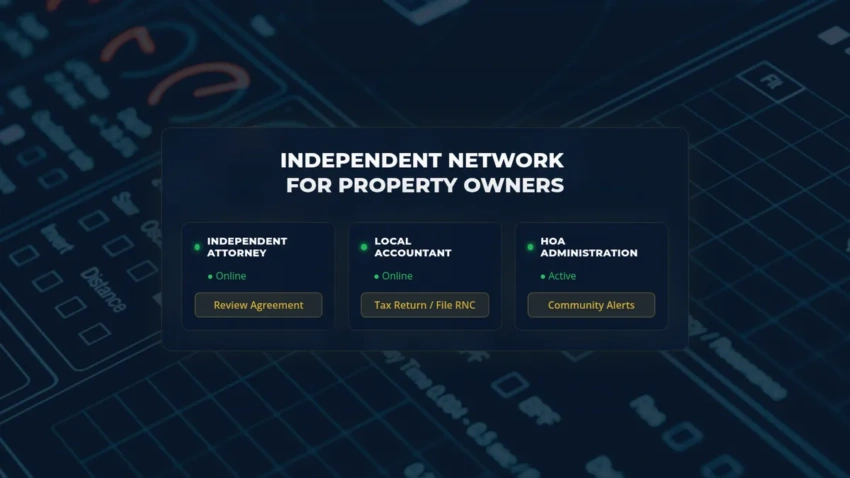
Essential independent contacts: attorney, local accountant, and HOA administration
Supplies and standardization of inventory
Many management companies create an operational dependency by insisting that exclusive linens, towels, and furniture be purchased through their in-house contractors. When the company leaves, the owner is forced to replace all textiles, as it becomes impossible to find matching items to replace those that have worn out.
We always recommend following the principle of standardization. During the staging phase, use high-quality yet widely available materials – such as durable textiles from IKEA or global brands available at hypermarkets in the Dominican Republic.
At CHM, we charge a flat commission (15%) for purchasing these materials. Purchasing standardized products with clear SKUs allows the owner to provide a new cleaning company with an inventory list at any time, enabling them to easily restock any damaged towels. You should always keep the inventory list and receipts on hand.
Professional photos and videos are the main drivers of sales. If the management company organizes a photo shoot (a service that we, for example, provide free of charge for our clients), the contract must clearly stipulate the owner’s right to purchase the original photo files at a fixed market price upon termination of the contract.
Exit Strategy & Structure of a Safe Property Management Agreement
Any business partnership may end due to changes in your life plans or in the market. The key to a smooth parting lies in a well-drafted contract and a streamlined financial structure.
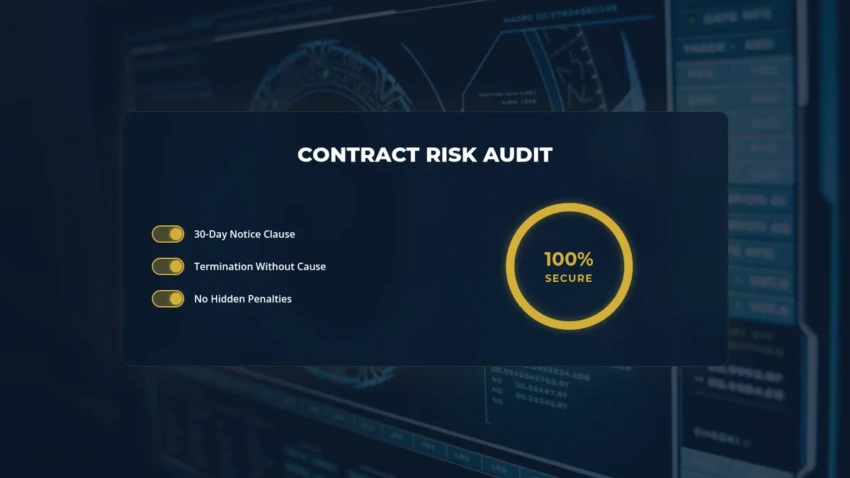
Secure agreement checklist: 30-day notice, no penalties, termination without cause
Legal protection in the contract (termination clauses)
When reviewing the contract, your independent attorney should pay close attention to the sections describing the terms of the agreement and the conditions for early termination.
- Term and auto-renewal. Most management companies require a 1- to 2-year contract. Therefore, the risk lies in auto-renewal clauses, which may require you to provide 90 days’ notice before the term expires. The best option is a 30-day written notice requirement.
- Grounds for termination. The contract must grant the owner the right to terminate “without cause” (Termination Without Cause), subject to a notice period. If the contract allows termination only “for cause,” you will have to legally prove the manager’s bad faith, which in the Dominican Republic’s court system can drag on for years.
- Hidden penalty fees. Unscrupulous companies include onerous terms – such as a requirement to pay lost profits for all remaining months of the contract in the event of early termination. Professional partners who are confident in the quality of their services focus on results and don’t retain clients with artificial penalties.
Split payouts technology
One of the most reliable technological solutions for protecting your income is the Split Payouts feature built into the Airbnb platform.
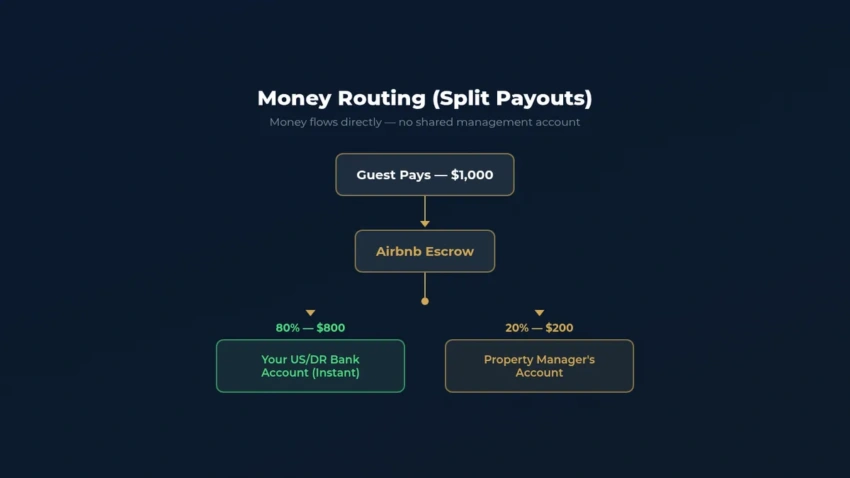
Direct cash flow to your account via automated routing rules
Consequently, instead of relying on traditional setups where managers hold your funds for a month, this automated system distributes payouts instantly:
-
- As the Primary Host, you go to the payment settings in your Airbnb account.
- In the payments section, you create a “Routing Rule.”
- The Airbnb platform acts as an impartial escrow agent.
- When funds are transferred (usually 24 hours after the guest’s arrival), Airbnb’s system automatically sends the agreed-upon percentage (for example, a co-host commission of 10%, 15%, or 20%) to the management company’s bank account.
- The remaining lion’s share (80-90%) is instantly transferred to your personal account in the U.S., Europe, or at Banco Popular in the DR.
3 benefits of split payouts:
- Extensive customization. You can configure the system so that 100% of the cleaning fee goes directly to the cleaning company. The commission is charged only on the base nightly rate. Third-party expenses do not skew your revenue statistics.
- Complete transparency. You don’t have to cross-check endless Excel spreadsheets from your manager against actual bookings, looking for hidden charges.
- Safe exit. If the contract is terminated, you, as the account owner, simply delete the routing rule, and 100% of the funds start flowing back to you. The money isn’t locked up in intermediaries’ accounts.
How to Avoid Dependence on External Contractors
in Property Management in the DR
To make sure everything runs smoothly, the owner must integrate the principles of systematic management into their business. Thus, operational processes should belong to the owner, not to a hired manager.
Channel diversification and direct bookings
This dependency stems not only from the management company but also from global booking platforms. Airbnb and Booking.com algorithms are constantly changing. Accounts can even be temporarily penalized due to a guest’s subjective complaint.
Increase net profit margin by 15% with direct villa bookings
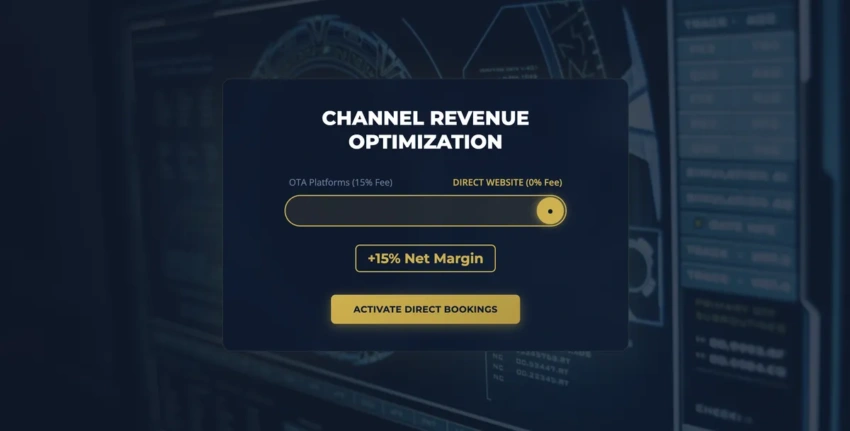
Based on our management experience, forward-thinking property owners always establish their own sales channels. High-quality management companies, such as CHM, offer services for developing independent websites (direct booking websites), landing pages, and payment gateway integrations.
- Property’s independent website. Having your own domain (e.g., luxury-villa-bavaro.com) with a booking module helps build a loyal customer base. Guests who initially booked through an OTA platform can book the villa directly on their return visit, saving both you and them up to 15% on service fees.
- Brand independence. If the domain name is registered in your name, this digital asset will remain yours forever. Even if you switch property management companies, the website will continue to generate bookings. All you’ll need to do is update the API key for the new property management system (PMS).
- Software Agnostic. Ensure that the management company uses software that supports open formats (like iCal) for calendar synchronization. This will prevent the contractor from “holding hostage” your facility’s schedule by claiming that exporting the data is technically impossible.
Financial modeling and pricing control
It is wrong to assume that, once you hire a management company, you can forget about strategic pricing. Moreover, blind reliance on automated pricing tools frequently leads to lost revenue because these programs fail to account for local Caribbean market nuances.
Therefore, we achieve the best results by combining dynamic technology with expert manual market monitoring. For example, our team analyzes trends and adjusts prices on a weekly basis:
- If a property remains vacant, we gradually lower the rate to attract guests.
- Once monthly occupancy reaches 60%, the price is raised to maximize revenue.
- When occupancy reaches 80%, aggressive markups (up to 50%) are applied to the remaining available dates on the calendar.
The pricing algorithm must be completely transparent to you. You should have access to dashboards so that you can clearly understand whether a drop in revenue in a given month is due to objective market trends in Punta Cana (such as the Sargassum season or the low season in September) rather than the manager’s inaction.
Standard operating procedures (SOPs)
Finally, your business needs to be documented. Standard operating procedures (SOPs) are step-by-step instructions on how your facility should operate. From how to properly reboot the local internet provider’s router and where the water shut-off valve is located, to instructions for pool maintenance.
If this knowledge is stored solely in the mind of a single local manager, you’re in a vulnerable position. Create a digital guide for your facility (Home Manual) and store it in the cloud, granting access to contractors.
Final thoughts
Owning a property for short-term rentals in the DR is an excellent way to grow your capital and generate a stable cash flow. The warm climate, growing demand, and unprecedented CONFOTUR tax incentives make it one of the best locations on the global real estate map.
However, as our experience shows, success comes to those owners who reject blind delegation in favor of a sensible partnership. To avoid becoming a hostage to the management company, you must treat your real estate as a systematic business from day one.
Professional management companies always support this approach. The Split Payouts feature, the development of proprietary websites for direct bookings, and flexible service scaling transform the relationship from one of dependency to an equal and mutually beneficial partnership. When you retain control over your business, your Dominican Republic property management team can focus on what matters most without fear, stress, or a loss of control.
If you own a property in the Dominican Republic, our expert team is ready to organize a smooth, secure, and hassle-free property management and help maximize your passive income.
Learn About Our Management Approach
FAQ on Property Management
in the Dominican Republic
Is it a good idea to buy property in the Dominican Republic?
Yes, it’s a great investment idea. Dominican Republic attracts buyers from all over the world thanks to its high yields and the opportunity to earn comfortable passive income. The warm climate, growing demand, and unprecedented tax incentives make this region one of the top locations on the global real estate map.
Is Airbnb profitable in Punta Cana?
Absolutely. Areas like Bávaro, El Cortecito, and Cocotal are in high demand for rentals thanks to their well-developed infrastructure and walking distance to beaches. Exclusive areas like Cap Cana command even higher rates.
With proper management – controlling energy costs, flexible pricing, and setting up direct bookings – Airbnb generates consistently high profits.
Can a foreigner own property in the Dominican Republic?
Yes, foreigners have the full right to acquire and own real estate under the same conditions as local residents. According to the Dominican Republic’s Civil Code, all real estate matters are governed by local law, regardless of whether the owner is a citizen or a foreigner.
Foreigners are also free to open accounts with local banks to conduct their rental business.
How much does it cost to build a 3 bedroom house in the Dominican Republic?
Construction costs vary greatly depending on the region, quality of materials, and level of finish. On average, building a comfort-class home costs between $800 and $1,000 per square meter, while premium projects in resort areas (such as Punta Cana) can cost between $1,200 and $1,500 per square meter.
Therefore, building a decent three-bedroom home (approximately 150-200 square meters) will cost approximately $150,000 to $250,000. It’s important to note that this cost does not include land purchase, landscaping, or pool construction.
Do you pay taxes on property in the Dominican Republic?
The default is yes: standard rates include a 3% transfer tax on purchases, a 1% annual property tax (IPI) on amounts over approximately $178,000, and a 20-27% tax on rental income.
However, thanks to the government program CONFOTUR (Law 158-01), if you invest in a certified tourism project, you can be completely exempt from paying these taxes for up to 15 years.
How much is 1 acre of land worth in the Dominican Republic?
The price for 1 acre (about 40 acres or 4000 sq. m) varies dramatically depending on the location, infrastructure and proximity to the ocean:
- Agricultural or remote areas. Prices can start from $10,000 to $50,000 per acre.
- Panoramic lots. Elevated land with mountain or ocean views typically costs between $100,000 and $800,000.
- First coastline and tourist centers. In prestigious areas (for example, Punta Cana or the Samana Peninsula), the cost of an acre is in the premium segment – from $500,000 to $1,500,000 and above.
What is the average price of Airbnb in the Dominican Republic?
The average daily rate (ADR) depends on the region, season, and type of accommodation. If we take the most popular location – Punta Cana – as a basis, the market situation looks like this:
- Private rooms and studios: $30-$80 per night.
- Apartments (1-2 bedrooms): $80-$200 per night (market average is about $110-$170 per night).
- Villas and luxury segment: from $300 to $1,000+ per night.
With an average annual occupancy rate of 35-48%, a typical Airbnb apartment in a popular area generates between $11,000 and $21,000 in gross revenue per year for the owner.
Is Punta Cana a good place to invest?
Yes, it is one of the most attractive and stable investment destinations in the Caribbean. Main reasons:
- Year-round demand. A constant flow of tourists from all over the world ensures high occupancy. Today, there are over 4,900 active Airbnb properties operating successfully in the region.
- Tax benefits. The CONFOTUR Law allows buyers of real estate in certified projects to be exempt from 3% tax upon registration of the transaction and from 1% annual property tax for up to 15 years.
- Infrastructure. The presence of the largest private international airport, excellent roads, international clinics and developed commerce ensures high liquidity of objects and comfort for both tourists and the owners themselves.
How much are villas in the Dominican Republic?
Villa prices vary depending on location, size, and level of exclusivity:
- In popular tourist areas, prices for small, comfortable villas start from approximately $250,000 to $500,000.
- At the premium end of the market, luxury villas with private pools are often priced at $800,000 and above.
- In exclusive gated communities, such as Cap Cana, the property itself is significantly more expensive.
What is the most expensive part when building a house?
Typically, the most expensive part of construction is the structural work – building the foundation, wood or concrete frame of the walls and roof. Often these basic elements spend from 15-20% to a third of the entire budget.
However, it is worth considering that interior decoration (especially the arrangement of kitchens, bathrooms and flooring) in total can also exceed the cost of constructing the frame itself, depending on the materials chosen.
What decreases property value the most?
There are several key factors that can dramatically depreciate the value of housing:
- Delayed repairs and structural issues. Roof damage, cracked foundations, old wiring, or plumbing problems are deterring buyers due to the huge costs ahead.
- Location problems. Proximity to noisy roads, increased crime, or deteriorating local infrastructure makes the property less attractive.
- Bad appearance (Curb Appeal). An unkempt exterior, overgrown lot, and shabby walls create a negative first impression on potential buyers.
In the context of the rental business. Loss of digital control. As noted in the article, if you lose your Airbnb profile with accumulated reviews and ratings, the value of your property as a “ready business” drops as your property becomes invisible to the algorithms.
Can you live in the Dominican Republic on $1500 a month?
Yes, quite possible. $1,500 per month allows one person to live a fairly comfortable lifestyle:
- A budget lifestyle (renting a modest place, buying local produce at markets) will cost approximately $800 to $1,200 per month.
- A comfortable lifestyle (a nice apartment in a safe area, health insurance, occasional dining out) costs between $1,500 and $2,500.
- A luxury lifestyle (living in a villa, expensive entertainment) starts at $3,000 and up.
Updated on: . Author: