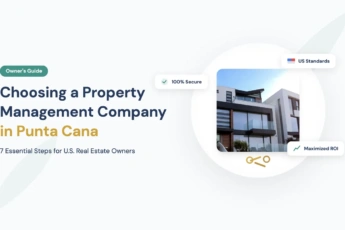

A Guide to Choosing a Property Management Company in Punta Cana – 7-Step Algorithm for US Property Owners in 2026
Owning real estate in Punta Cana is a wonderful way to earn a steady passive income. However, to maximize it, choosing a property management company is the most critical decision you will make. Whether it’s a cozy oceanfront apartment in Los Corales or a luxurious villa overlooking the golf courses in Cocotal, the Dominican Republic’s real estate market offers tremendous opportunities.
7 essential steps for US owners when choosing a property management company
However, for most owners who live permanently in Miami, New York, or other U.S. cities, managing a property remotely can be a challenge. Time zone differences, language barriers, the specifics of local laws, and the simple fact that they cannot personally meet guests or check on cleaning services make it necessary to delegate these tasks to local pros.
If you feel that your current property management company (PMC) isn’t up to the task, there’s no need to panic. Changing it is a standard business process. Drawing on Complete Hospitality Management’s (CHM) many years of experience managing real estate in the DR, our experts have prepared a detailed guide to help American property owners make an informed and safe choice when selecting a new operator.
Verification & Audit Methodology When Choosing
a Property Management Company in Punta Cana
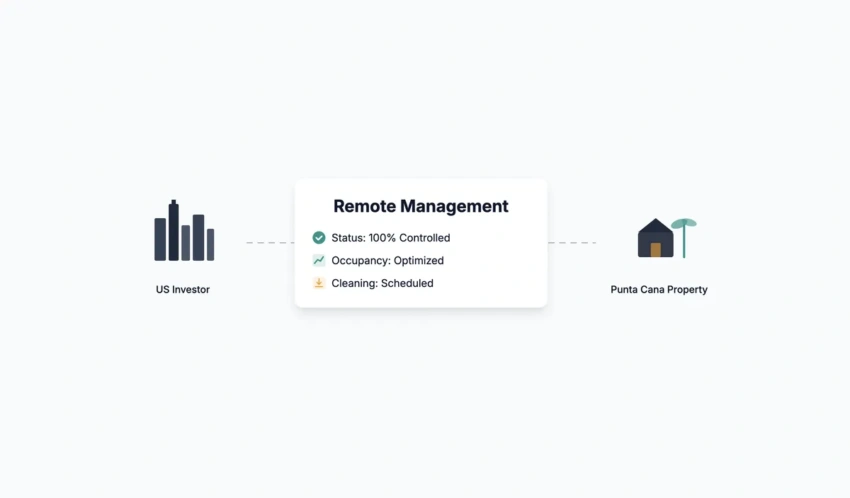
Managing Dominican real estate remotely from the US
When selecting a new partner, a property owner must conduct a thorough review of the partner’s legal status, financial transparency, and operational capabilities. In the DR, the real estate management industry is strictly regulated, and failure to follow basic procedures can lead to tax and administrative risks.
Vetting a property manager’s legal status: RNC & DGII
The first step when choosing a property management company is to verify that the company is registered in the National Taxpayers Registry (Registro Nacional de Contribuyentes – RNC). This registry is administered by the General Directorate of Internal Revenue of the Dominican Republic (DGII). An active RNC number indicates that the legal entity is operating legally and filing tax returns.
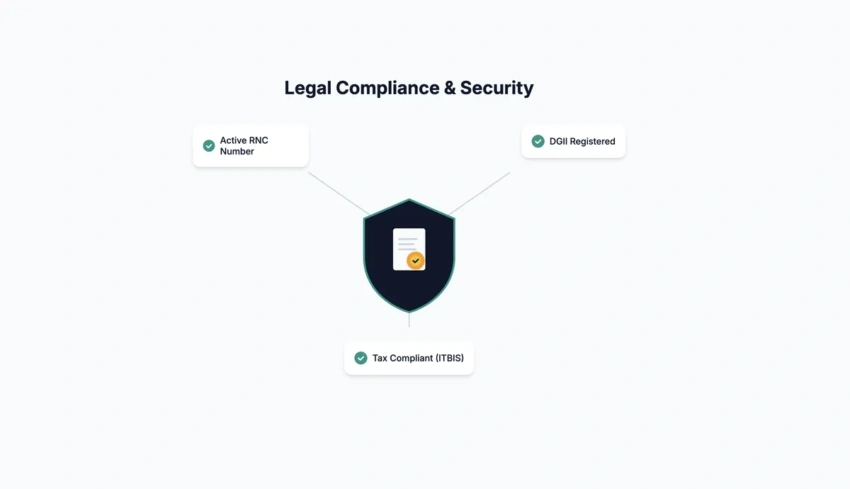
Verify RNC and DGII registration before signing
The importance of this aspect stems from the requirement to pay ITBIS (a local VAT of 18%) on all services provided. A legitimate management company is required to issue official tax invoices (comprobantes fiscales – NCF). Working with unlicensed agents (“freelancers” without an RNC) deprives the owner of legal protection and makes it impossible to officially declare expenses to reduce the tax base.
Auditing a rental agency’s reputation on Airbnb and VRBO
To verify a company’s professionalism in the short-term rental sector, it is not enough to review the information on its corporate website. Performance metrics on international online booking platforms (OTAs – Online Travel Agencies) serve as an objective evaluation criterion.
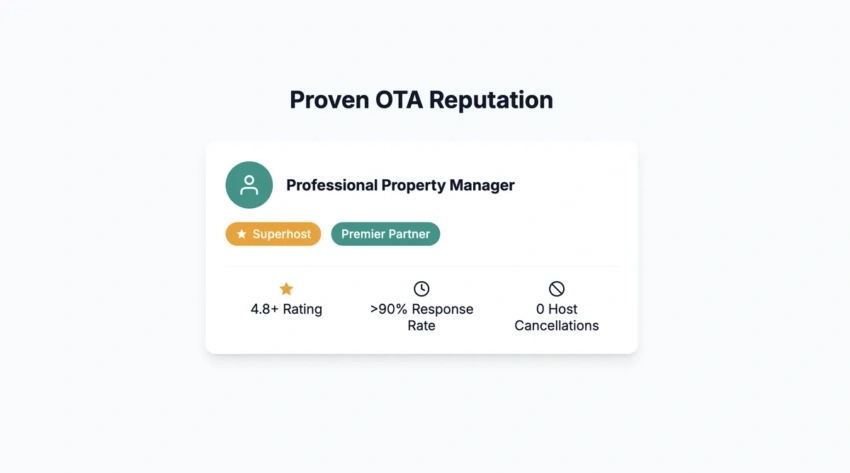
Always check for Superhost and Premier Partner statuses
CHM’s practical experience confirms that a key indicator is whether the properties managed by the company hold Airbnb Superhost or VRBO Premier Partner status. These statuses are awarded automatically based on strict metrics: the rate of timely responses to guests must exceed 90%, the property rating must be at least 4.8, and the number of host-initiated cancellations should be close to zero.
Why hiring a management firm based on low fees is risky
Based on our experience managing residential complexes and villas in Punta Cana, we caution US owners when choosing a property management company against working with companies that offer commissions below market standards (less than 10-15% for basic services). Price dumping in the hospitality industry inevitably leads to cost-cutting in operational processes.
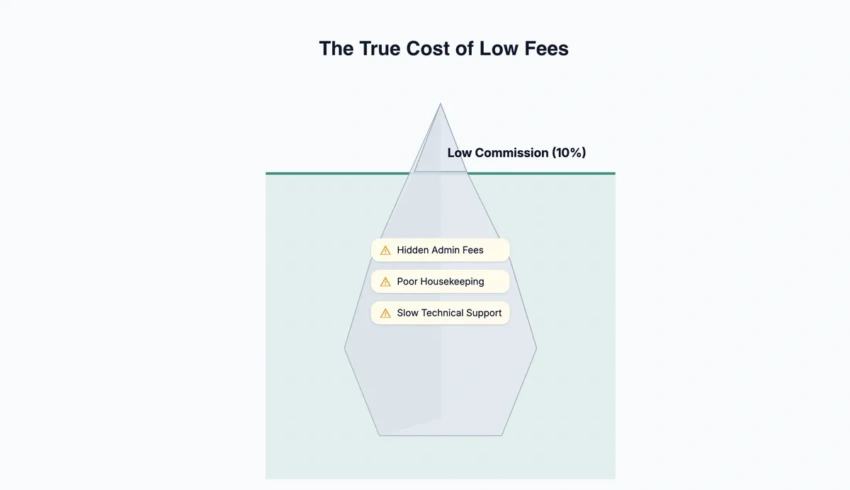
The hidden costs of cheap management services
This manifests itself in the hiring of unqualified housekeeping staff, a lack of 24/7 guest support, slow response times to technical issues, and the emergence of hidden administrative fees that are passed on to the owner. High-quality service requires maintaining a permanent staff of supervisors, technicians, and booking channel managers.
Comparative analysis of operators
To illustrate the differences between a professional, licensed operator and informal agents, a comparison is provided below.
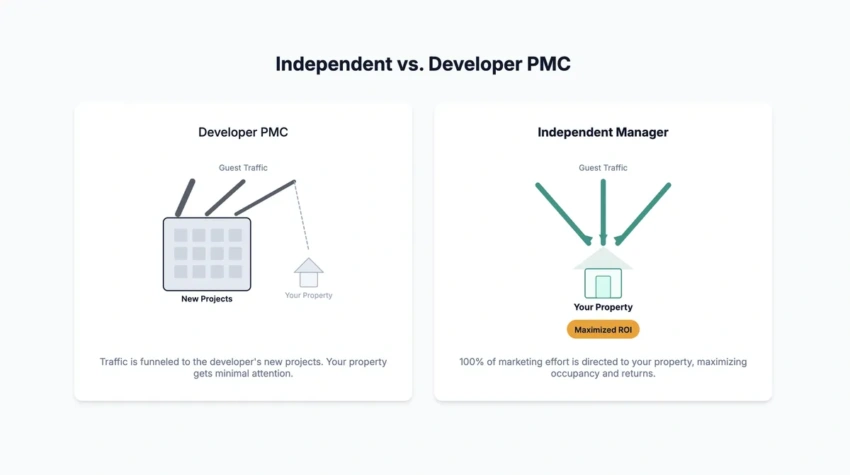
Independent operators prioritize your property’s ROI
Licensed property management company vs. independent agent
| Verification parameter | Professional licensed operator | Informal agent / freelancer |
|---|---|---|
| Tax status (RNC) | Registration in the DGII register, issuance of official NCF accounts. | No official registration, work for cash. |
| Legal liability | Full legal liability under the management agreement. | Lack of legal guarantees, risks of personal liability of the owner. |
| OTA partnership level | Airbnb Superhost, VRBO Premier Partner statuses, integration via PMS. | Regular user accounts without system synchronization. |
| Staff | Bilingual specialists, our own mobile teams of technicians and cleaners. | Involvement of random outsourcers as needed. |
| Dynamic pricing | AI algorithms that take into account weather, hotel occupancy, and flights. | Manual setting of fixed prices without taking into account market fluctuations. |
Questions Before Choosing a Property
Management Company in Punta Cana
Before signing a property management agreement, we recommend conducting a structured interview with representatives of the management company. This will help identify potential discrepancies in business models even before the keys to the property are handed over.
Defining your potential management partner’s true specialization
Many real estate agencies in Punta Cana position themselves as full-service firms, but their primary focus is on buy-sell transactions that generate a one-time, high commission. In such organizations, the rental management department is often funded on a residual basis, and its staff lacks in-depth expertise in hospitality and revenue management.
Specialized management companies, such as CHM, concentrate all their resources on operational management, marketing, and maintaining high standards of guest service, which directly translates into high occupancy rates and maximized profits.
Questions to ask when interviewing a property manager
It is advisable for U.S.-based property owners in Punta Cana to send the following list of questions to assess the PMC’s level of professionalism:
What percentage of your total revenue comes from rental transactions?
The answer helps determine whether rental management is a core business focus or a secondary service.
On how many international booking platforms will listings be posted?
Leading operators use multi-channel distribution, listing properties on more than 35 OTA channels (including Airbnb, Booking.com, Expedia, and VRBO) and their own direct booking websites.
How exactly does your technical support team handle emergencies outside of business hours?
A professional company should have 24/7 support and on-call mobile response teams in Punta Cana.
What are the average occupancy rate and average daily rate for similar properties at my resort over the past year?
Our experience shows that a professional operator immediately provides statistical data backed by reports from analytics systems.
The Importance of Independence for
a Property Management Company
In the DR’s real estate market, it is common for large developers to establish their own subsidiary management companies. Among the best-known developers in the region are Noval Properties (brands: Constructora Noval, Casa by Noval, Caribbean Connection) and Gesproin Group (management entity: GVR – Gesproin Vacation Rentals). At first glance, transferring a property to the developer’s management company seems like the simplest solution. However, a detailed analysis reveals hidden systemic risks and conflicts of interest in such an arrangement.
Avoiding developer conflicts when picking a management partner
The primary goal of any developer is to sell properties under construction in new phases and to scale up the development business. An in-house management company is often used as a marketing tool to demonstrate high profitability to potential buyers.
Based on our experience in the DR, it is clear that in a highly competitive environment, guest traffic may be artificially redirected to properties in new, recently completed complexes (such as Ocean Hotel Boutique or Poseidonia Residences by Noval, or Secret Garden and Marina Garden by Gesproin) to stimulate sales of the remaining units. Meanwhile, properties established earlier in older phases of the project may suffer from a lack of attention from management.
The financial benefits of hiring an independent operator
Companies affiliated with the developer operate under strict corporate regulations. They tend to impose monopoly rates for maintenance, cleaning, and the replacement of consumables purchased from affiliated suppliers, which significantly reduces the owner’s net operating profit.
As an independent operator – CHM – we are completely free from obligations to developers. The success of an independent company depends directly on the owner’s net profit, since the commission is calculated as a percentage of actual revenue. This compels independent management to continuously optimize operating expenses, seek out the most cost-effective local contractors, and use flexible marketing tools to attract affluent guests from the U.S. and Canada.
Why Local Presence in Punta Cana is Key
When Choosing a Property Management Company
One of the key factors in successful management is the density of a management company’s presence in a specific location. Whether an operator has a portfolio of properties in the same residential complex or within several hundred meters of the owner’s property is a critical operational criterion.
Logistics and operational response time
The resort industry requires an immediate response to guest requests. In the event of technical issues (such as an AC failure or a water leak), the fact that the management company’s technical services are located far away will result in long wait times, which will inevitably lead to negative reviews on Airbnb and a lower listing rating.
Drawing on our knowledge in the DR, we have properties concentrated in one area, which allows us to maintain a permanent staff of supervisors, housekeepers, and technical specialists directly on the residence’s premises. This ensures that any guest issues are resolved within 15-20 minutes, guarantees the highest level of quality control for cleaning before each check-in, and reduces transportation costs, allowing the company to maintain competitive commission rates.
Survey of micro-locations in Punta Cana
Punta Cana is not a single, homogeneous market, but rather a collection of neighborhoods, each with its own unique characteristics, target audience, and homeowners’ association (HOA) rules. The table below outlines the characteristics of the key areas.
Management specifics by area in Punta Cana
| Location in Punta Cana | Target audience and type of objects | Control specifics and operator requirements |
|---|---|---|
| Los Corales / El Cortecito | Active tourists, surfers, and young people. Mid-priced apartments, studios, and townhouses. | Punta Cana’s “Little Italy.” Easy walking distance to restaurants and the beach. Requires dynamic daily pricing and fast cleaning turnaround. |
| Cap Cana | Budget travelers, families. Luxury oceanfront villas, upscale marina apartments. | A gated, elite area with a strict access control system. Experience managing complex systems (pools, landscapes) and providing personal chefs and butlers is required. |
| Cocotal Golf & Country Club | Golf enthusiasts, long-term renters, and families. Villas and duplexes on the golf course’s front line. | Strict Home Owners Association (HOA) regulations regarding noise and parking require experience in resolving disputes with golf club management. |
Legal Basis and Structure of
a Property Management Agreement
A Property Management Agreement is a basic document that governs the financial and legal relationships between the parties when choosing a property management company. The document must be drafted in accordance with the Civil Code of the Dominican Republic and the relevant lease laws.
Essential terms of the contract
Based on CHM’s best practices, the contract must include the following sections:
- Limits on minor repairs (maintenance spending authority). To avoid constant back-and-forth over minor operational issues, the contract specifies the manager’s spending authority (for example, up to $150-$200 per incident). All expenses exceeding this limit require written approval from the owner.
- Termination clause. The contract must include terms for a transparent and smooth termination of the partnership. The standard notice period for termination ranges from 30 to 90 days. Contracts that impose excessive penalties for early termination create exploitative conditions and indicate the provider’s lack of good faith.
- Handling of future reservations. A professional contract always details the procedure for transferring active reservations upon termination of the agreement. There must be a mechanism in place whereby confirmed reservations are either managed by the former manager until the guests’ departure date or seamlessly transferred to the new company, with commission compensation.
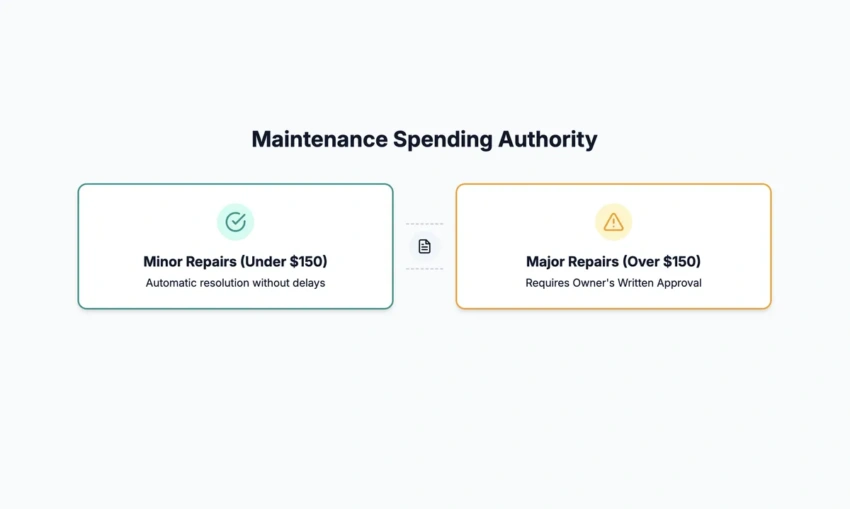
Set clear maintenance spending limits in your contract
Why your new property manager must understand DR lease laws
It is extremely important for U.S. property owners to note that Law No. 85-25 on the Regulation of Real Estate Leases and Evictions came into effect in the DR in August 2025. This law has significantly modernized the rules governing leases and security deposits.
Under Law No. 85-25, all security deposits must be deposited into special accounts at the Agricultural Bank (Banco Agrícola de la República Dominicana) within a specified period after the lease agreement is signed. In addition, the law strictly regulates the pre-trial dispute resolution process and the procedure for evicting non-compliant tenants through specialized courts. The new management company must demonstrate a thorough understanding of these reforms and clearly outline in the contract the steps for complying with the requirements of Law No. 85-25.
Strategies for Minimizing Critical Dependence on the Management Company
The most common mistake made by foreign owners is to completely hand over control of digital and physical assets to the management company without maintaining backup management channels. If disputes arise or service quality declines, the owner risks completely losing the property’s hard-earned online reputation.
Using the co-hosting model with your new management partner
In the short-term rental industry, the standard practice is for the property owner to retain ownership of the Airbnb account. Instead of creating a listing on the management company’s profile, the owner should register their own account and invite the management company to act as a co-host with full operational rights.
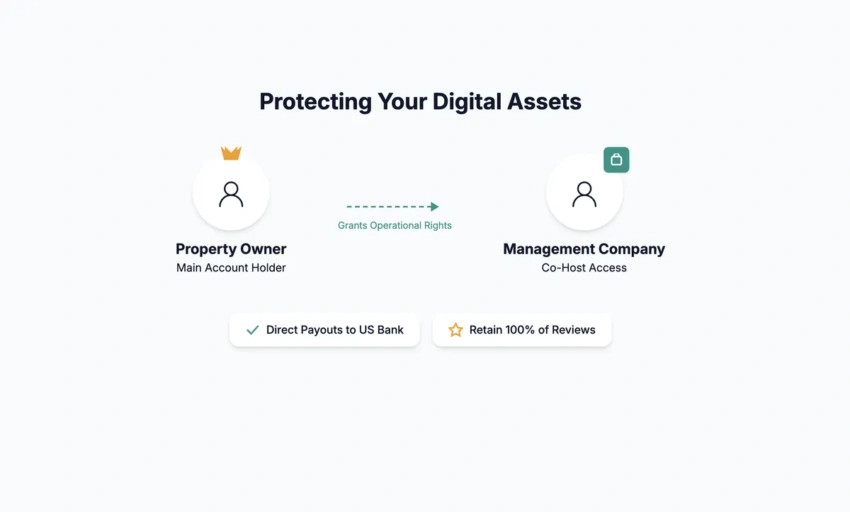
Retain 100% control with the co-hosting model
This approach addresses three key objectives:
- Preservation of intangible assets. All guest reviews, historical occupancy data, and Superhost status are tied to the owner’s account. If the property management company changes, it is simply a matter of removing the co-host from the system, while retaining 100% of the listing’s accumulated reputation.
- Direct financial control. Payouts from bookings are sent directly from Airbnb’s payment system to the owner’s bank account in the U.S. The management company cannot access or change the owner’s payment details. Management fees are calculated based on monthly reports.
- Transparent communication. The owner can log into the app at any time to view actual correspondence with guests, actual nightly rates, and cleaning status, eliminating any possibility of manipulation by local staff.
Maintaining utility autonomy when working with a PMC
To prevent operational blackmail by unscrupulous contractors, all contracts for utility services (internet, electricity, water) must be drawn up directly in the name of the property owner or their Dominican legal entity (SRL).
Payment of utility bills and HOA’s dues may be handled by the management company, but the payment accounts must be monitored by the owner. Installing smart locks with remote access and noise monitoring systems allows the owner to control access to the property from anywhere in the world, regardless of the manager’s actions.
18-Day Transition Plan to New Management Company & Onboarding Guidelines
The transition to the new operator must follow a strict schedule that avoids any operational downtime. Based on our experience in the Dominican Republic, the standard period for full integration and the launch of sales is approx. 18 days.
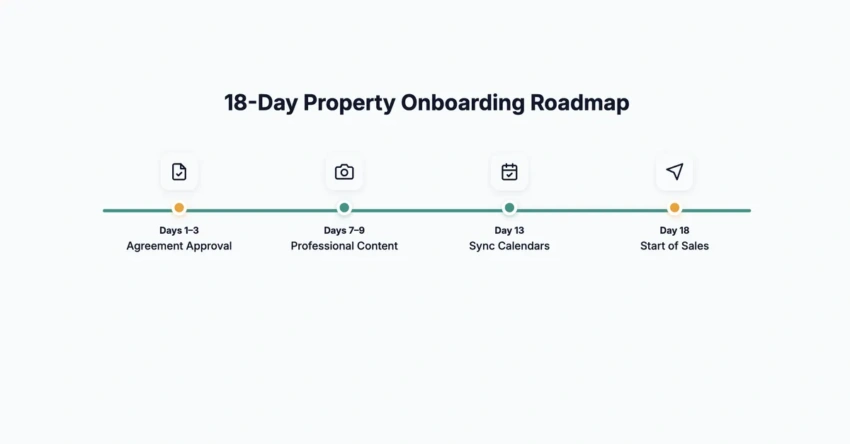
18-day roadmap for a smooth transition
Roadmap for onboarding a new facility
Below is a table that describes each stage of the transition and sales launch in detail.
18-day step-by-step property onboarding plan
| Process days | Stage name | Operational content and objectives of the stage | Stage result |
|---|---|---|---|
| Day 1-3 | Agreement approval | Detailed analysis of legal terms, discussion of tariff plans, and signing of the agreement. | Signed legitimate management agreement. |
| Day 4 | Kick-off meeting | Conducting a personal or virtual meeting with the coordinator, distributing areas of responsibility. | Approved operational integration plan. |
| Day 5-6 | Texts and parameters | Creation of professional multilingual descriptions, inventory, and listing settings. | A generated database of object characteristics. |
| Day 7-9 | Professional content | Conducting interior photography and preparing video presentations (important for OTA algorithms). | A set of high-resolution media files. |
| Day 10-12 | Pricing and promotions | Integrate the property into the PMS system, set up dynamic pricing and introductory discounts for promotion. | A ready-made tariff grid with a planning depth of up to a year. |
| Day 13 | Sync calendars | Setting up Channel Manager, merging calendars to prevent overbooking. | A single booking database protected from overlaps. |
| Day 14-17 | OTA profiling | Deployment and optimization of ads on 35+ international platforms. | Active and optimized ads on the network. |
| Day 18 | Setting up communication | Loading automatic response templates, integrating triggered messages for guests. | Start of sales and first flow of bookings. |
7 Steps to Choosing a Property Management Company
in Punta Cana for U.S. Residents
The process of changing property management companies may seem complicated, but with the right approach, it ensures the safety of your property and increased returns. We’ve broken down the entire process into seven sequential steps – from the initial legal audit to the final financial reconciliation – so you can structure your partnership with maximum transparency.
1. How to check a new management company “on the ground”
Before entrusting the keys to your property to a new partner, you must conduct a thorough check of their reputation and legal status in the DR:
- Legal registration. Make sure the company is officially registered with Dominican government agencies, specifically the Internal Revenue Service (DGII). This ensures the company operates legally and protects you from legal risks.
- Reputation on independent platforms. Check reviews not only on the company’s official website but also on independent, reputable platforms such as Trustpilot or Google My Business profiles. Pay attention to how the company responds to reviews and resolves any issues that arise.
- Analysis of active listings. Find the company’s profiles on Airbnb, Vrbo, or Booking.com. Take a look at how their current listings are presented: Are the photos high-quality? How promptly do managers respond to guests’ questions? And what is their average rating?
- Direct contact with fellow property owners. Based on our experience, we always recommend asking a potential PMC for the contact information of several current property owners who are already working with them. An honest review from a fellow is worth more than a dozen promotional brochures.
2. Key questions to ask before getting started
A well-structured conversation with a potential partner allows you to immediately rule out unqualified agencies. We’ve put together a handy checklist of questions to help you assess a property management company’s professionalism before signing a contract.
Evaluation criteria for management company interviews
| Question for the management company | What this question clarifies | ‘Green flag’ (good answer) | ‘Red flag’ (a reason to think) |
|---|---|---|---|
| How are income and expenses distributed? | Transparency of the financial model | The commission is withheld only from actual income (revenue share); reports include details of all expenses. | The presence of hidden fixed payments or fees for the “downtime” of the facility. |
| Who owns the accounts on the booking platforms? | Your independence and security | You remain the main owner of the account, and the management company is added as a co-host. | The management company insists on creating ads exclusively in its closed profile. |
| How do you deal with the low season? | Flexibility of marketing strategy | Using dynamic pricing algorithms and presence on 35+ channels. | Manual price reduction “by eye” or focusing on only one platform. |
| How is your technical support service organized? | Speed of property maintenance | Our own team of craftsmen and contractors, ready to arrive at the site within half an hour. | Using third-party on-call technicians, whom you have to wait for days. |
3. Power of independence: why new management must be truly independent
In the Punta Cana real estate market, it is common to find property management companies affiliated with developers or large HOAs. At first glance, this seems convenient: they are always on-site and know the property inside and out. However, this presents a serious conflict of interest.
Developers are mostly interested in selling new phases of their projects, and the management companies affiliated with them often market for rent those properties owned by the developer itself or by major investors. Furthermore, such companies are often constrained by the residence’s internal rules and standards, which limit their flexibility.
True independence of the management company means its sole priority will be to maximize the profitability of your specific property. Independent management has greater freedom in choosing marketing tools, doesn’t impose inflated rates from the residence’s in-house contractors, and protects the interests of the owner rather than those of the construction corporation.
4. Location of facilities: why it’s important to have a management company right in your residence or nearby
Punta Cana is a vast region with distinct local characteristics. The rules for entry, beach access, and use of infrastructure in Cap Cana, Cocotal, or Los Corales vary significantly.
The management company must have a physical presence and operational facilities directly within your residence or within a few minutes’ drive of it. This is critically important for several reasons:
- Understanding local regulations. In communities like Cocotal Golf & Country Club, there are strict rules regarding security, guest access, golf cart rentals, and noise limits. Experience working within a specific community allows the management company to avoid fines for the owner and conflicts with neighbors.
- Established contacts with the community administration. Local managers personally know the security staff, the community’s technical services, and the beach club administrators. This helps resolve any daily or organizational issues guests may have immediately.
- In-depth knowledge of the infrastructure. A local manager can always recommend the best restaurants in Los Corales to guests or book a tee time at the Cocotal golf courses. This directly impacts the quality of guest reviews and their desire to return.
5. Local concentration of resources: the key to a rapid response
The Dominican Republic is a tropical paradise, but the local climate places increased demands on property maintenance. High humidity, the scorching sun, and sea salt carried by the ocean breeze accelerate wear and tear on equipment.
ACs, plumbing, locks, and household appliances may require urgent repairs at the most unexpected moments. This is where the local concentration of the property management company’s facilities plays a key role.
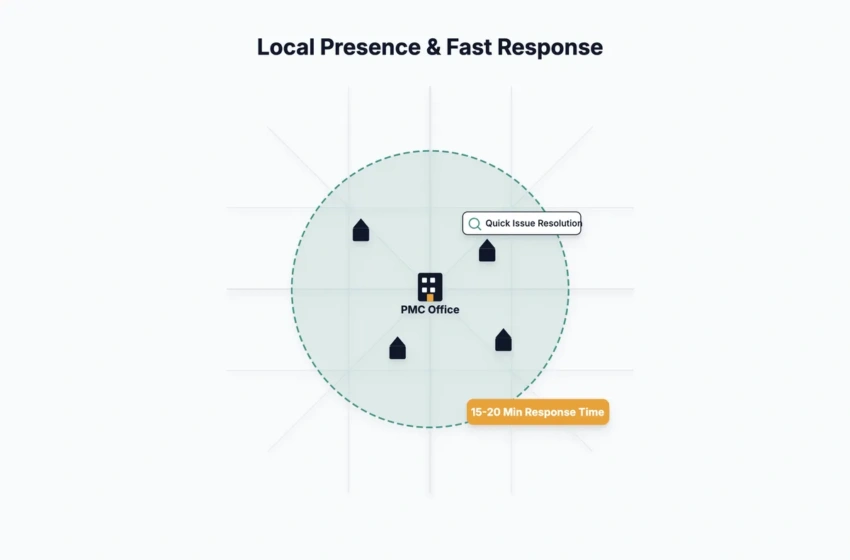
Local presence ensures rapid guest support
Local concentration of the management company’s properties:
- Fast response times (supervisors and technicians are always nearby);
- Optimization of cleaning costs and the procurement of supplies;
- Immediate resolution of emergencies within 15-30 minutes.
If a management company’s properties are concentrated in one or two areas (for example, in Bavaro and Punta Cana), its mobile teams are constantly on the move within those zones. If a guest’s AC starts leaking at 10:00 p.m., a technician will arrive within 15 minutes. But if the company’s properties are far away, guests will wait for hours in the heat for help, which is guaranteed to result in a bad review and a drop in your listing’s ranking.
6. Contract with a new property management company and what to look for
A property management agreement is the foundation of your long-term peace of mind and financial security. We strongly recommend consulting a local attorney specializing in this field before signing, but you should at least review the following points:
- Fee structure (commission). Clearly specify the commission rate (typically 15-30% in the market, depending on the service package and marketing efforts). Make sure the commission is calculated based on actual net or gross rental income, rather than a fixed amount that you’ll have to pay even when there are no guests.
- Breakdown of expenses. The contract must clearly specify which expenses the company covers (e.g., ads, booking platform fees, basic cleaning) and which the owner pays (utilities, major repairs, replacement of linens).
- Terms for terminating the contract. The relationship should be based on mutual trust and comfort. The contract must include an exit clause. The optimal option is 30- or 60-day notice prior to the planned termination date, without penalties or complicated legal procedures.
- Regularity and transparency of reports. Specify the management company’s obligation to provide monthly financial reports confirming all reservations and expenses.
7. How to avoid falling into the trap of critical dependency
The most common problem that property owners bring to us at CHM when replacing their old management team is the loss of digital assets.
Many agencies create listings for your villa or apartment on their own profiles on Airbnb or Booking.com. As they accumulate dozens of five-star reviews and earn “Superhost” status, that account becomes the property of the company. If you decide to part ways with such a management company, they’ll simply delete your listing. You’ll have to start from scratch, losing months and thousands of dollars in lost revenue.
To prevent this from happening, choose a company that respects your independence:
- Account ownership. Insist that all personal accounts on OTA platforms (Airbnb, Vrbo, Booking.com) be created in your name or transferred to you. The management company should connect to these accounts via a co-hosting system or professional channel managers.
- Direct access to finances. You should be able to view all incoming payments and reservations in real time. Modern technology allows you to set up split payments, where your share of the revenue is sent directly to your bank account.
- Preservation of history. When you switch management companies, your reviews, rating, and search engine rankings should remain with you. This is your intangible asset that increases the property’s value on the market.
To sum up the above
Choosing a new property management company in Punta Cana is an excellent opportunity to renew your rental business and make it more profitable and transparent. There’s no need to fear change. The key is to approach the process pragmatically, verify your partners’ local experience, and maintain control over your digital assets.
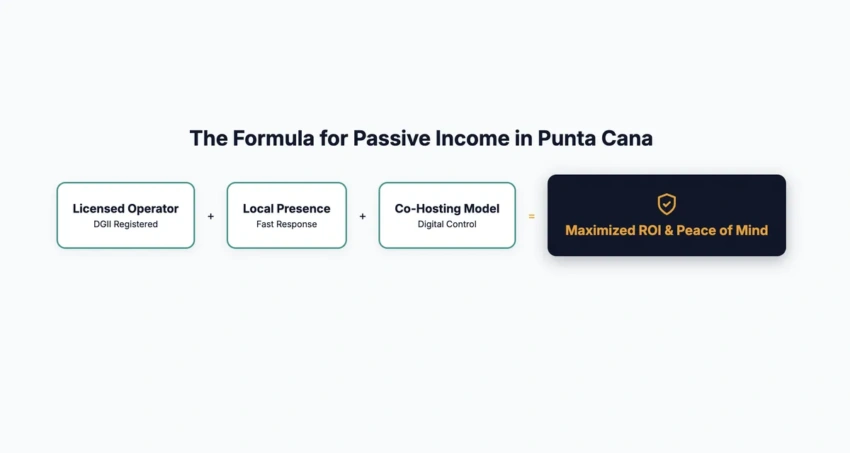
The formula for safe and profitable investments
With 10+ years of experience managing real estate in the Dominican Republic, we at CHM have structured our processes to ensure U.S. owners feel completely at ease. We use cutting-edge technologies for automation, dynamic pricing, and transparent reporting, guaranteeing that your property is in reliable hands 24/7.
If you’d like to discuss the potential of your villa or apartment in Punta Cana or receive an audit of your current listing, please contact us – we’d be happy to share our expertise!
Find Out About Our Management Approach
FAQ on Choosing a Property Management
Company in Punta Cana
What is the 2% rule for properties?
The 2% Rule is a quick mathematical test that investors use to determine whether a property will generate a good return. The concept is simple: the monthly rent should be at least 2% of the property’s purchase price.
- Imagine you bought an apartment for $100,000. According to the 2% rule, for the investment to be considered highly profitable, you must rent out that apartment for at least $2,000 a month.
In reality, especially in popular resort destinations like Punta Cana or in expensive U.S. cities, achieving 2% is nearly impossible (due to the high cost of the properties themselves). There, even 1% or 1.5% is considered an excellent return. But this rule works perfectly well for a basic return-on-investment calculation.
What should I expect from a property management company?
A good property management company takes care of all the “headaches” so that you can simply enjoy passive income. You should expect them to provide a full range of services.
Here’s a basic list of what they’re required to do:
- Marketing and sales. Posting attractive photos on Airbnb, setting prices, and attracting guests.
- 24/7 communication. Answering guests’ questions day and night, and handling check-ins and check-outs.
- Property maintenance. Thorough cleaning after each guest, laundry, and restocking supplies (soap, toilet paper).
- Transparent accounting. Providing a clear report at the end of the month (how much you earned, how much you spent on cleaning, and what your net profit is).
For instance, if a guest has a burst pipe or a broken air conditioner at 2 a.m., the management company sends a technician to fix the problem. Meanwhile, you’re sleeping soundly in the U.S.
What are good goals for a property manager?
Your manager’s main task is to ensure that your property increases in value and generates maximum revenue. Their work can be broken down into three main objectives:
- Maximizing profit (ROI). Not just renting the property to the first person who comes along, but renting it at the best possible price. To do this, they must monitor the market and raise prices during holidays or peak season.
- Maintaining the property’s condition. Ensuring that furniture doesn’t break, appliances are serviced on time, and the walls remain clean.
- Happy guests. Getting 5-star reviews.
Let’s imagine the manager gives guests a small surprise (leaves a basket of fruit). The guests are delighted and give a 5-star rating on Airbnb. Thanks to this, your villa’s rating goes up, and next month you can rent it out for 15% more.
What is the biggest responsibility for property management?
The greatest responsibility of any property management company is to fully protect your asset. This means they act as your shield against any physical or legal risks.
They are responsible for:
- Tenant screening: preventing noisy groups from moving in that could damage the building.
- Security: checking that doors are locked and that security cameras and smoke detectors are working.
- Compliance: ensuring that community (condo) rules and state laws are not violated so that you do not receive a hefty fine.
Imagine a guest decides to throw a loud pool party, which is prohibited by the complex’s rules. The management company’s responsibility is to arrive on the scene immediately, calm the situation down, or evict the violators before the complex administration issues you a fine of several hundred dollars.
What are the top 10 questions to ask a property manager?
During an interview with a potential partner, don’t hesitate to ask direct questions. Here are the top 10 questions to help you choose the right professionals:
- How is your commission calculated, and are there any hidden fees? (The commission should be based only on actual income.)
- In whose name will the Airbnb and Booking accounts be created? (They should be in your name.)
- How quickly does your maintenance service respond to calls outside of business hours?
- What services are included in the commission, and what do I pay for separately? (For example, who pays for laundry?)
- How do you set rental prices? (Manually or using smart dynamic pricing software?)
- On how many international platforms will my property be listed? (Ideally, on 30+ channels.)
- Does your company have an official license and tax status?
- Who pays for minor repairs in the house?
- Can you show revenue statistics for similar properties in my neighborhood?
- What are the terms for terminating the contract if I’m not satisfied with the service?
By asking question #2 (about accounts), you’ll immediately understand who you’re dealing with. If the company insists on listing your apartment on their private profile, it’s an attempt to tie you to them.
Why do you need a property management company?
If you live in another country or city, managing your property on your own can be extremely stressful. A property management company is there to help you earn passive income, not to give you a second job.
They take care of all the routine tasks:
- They break down language barriers and handle legal issues – they’re familiar with local specifics, taxes, and residency regulations.
- They save you time, so you don’t have to wake up in the middle of the night to respond to a guest.
- They keep the property in perfect condition, they arrange for cleaning, pool maintenance, and repairs.
You live in New York, but your apartment is in Punta Cana. It’s physically impossible to personally meet guests, hand them the keys, or urgently repair a broken air conditioner. That’s exactly why you need local specialists.
What are red flags for landlords?
“Red flags” are signs that you should steer clear of such an agency.
- Dumping (a commission below 10–15%). If a company charges suspiciously little, it means it will cut corners on cleaning quality or add hidden fees to your bill.
- Operating without official registration. If the company doesn’t have a tax ID number (for example, an RNC in the Dominican Republic), you aren’t legally protected and won’t be able to claim the expenses as tax deductions.
- Lack of direct access. If the company won’t let you review financial reports or correspondence with guests.
- Slow responses. If a manager takes two days to reply to your email, imagine how long your guests will have to wait for a response.
You’re reading the contract and see a clause stating that you’re required to pay the company a fixed amount every month, even if your apartment is vacant and not generating any income. That’s a major red flag!
What to say in an interview for property management?
Treat this conversation as if you were hiring an employee. You’re the boss, and you need to set the right expectations.
What to say and ask:
- Outline your main goals. Say, “The most important thing to me is that the villa remains in perfect condition, since I vacation there with my family myself,” or, conversely: “I need maximum occupancy and profit.”
- Ask for real-life examples. Say: “Show me links to other properties you’re currently managing on Airbnb. I want to look at the quality of the photos and the guest reviews.”
- Discuss worst-case scenarios. Ask: “Tell me how you handled the last time guests broke furniture or flooded the neighbors’ unit.”
- Set spending limits. Say: “I’m willing to approve minor repairs (up to $150) without my involvement so you can work quickly. But we must agree on all major expenses in writing.”
Don’t hesitate to be demanding. Say directly, “Transparency is critical to me. Will I be able to see all bookings and money transfers in real time?” The confidence in their response will help you determine whether you can trust them.
What is the most significant benefit of effective property management?
The main advantage is genuine passive income and peace of mind. Effective management transforms your property from a second, exhausting job into a reliable financial asset.
Here’s what proper management offers:
- Saves you time. You don’t have to spend hours dealing with guests, finding cleaners, or fixing plumbing.
- Increased profits. Professionals know how to craft an attractive listing, where to post it, and how to dynamically adjust prices to maximize earnings.
- Asset protection. Regular maintenance and guest screenings keep your home in perfect condition for years to come.
For example, you can focus on your day job or relax in the U.S., while rental income from your villa in Punta Cana flows regularly into your account. The manager handles all late-night calls from guests and emergency repairs.
What is the biggest risk of owning a rental property?
The biggest risk is problematic tenants and long periods of vacancy (when the property sits empty).
This can hit your wallet in several ways at once:
- Property damage. Damaged renovations, broken appliances, or ruined furniture can cost thousands of dollars.
- Non-payment of rent. Guests or long-term tenants may stop paying, and evicting them legally can take many months.
- Hidden costs. An unnoticed water leak or mold caused by poor ventilation can lead to major repairs.
Let’s say you rented out an expensive apartment without thoroughly screening the guests. They threw a loud party, broke the TV, and flooded the neighbors’ unit. As a result, your entire income for the season went toward covering the damage and fines from the condominium association. A professional property management company mitigates this risk through strict tenant screening and security deposits.
What is swot in property management?
SWOT is a very simple and popular method for evaluating your property (or your competitors). It’s an acronym made up of four words that helps you understand how attractive your property is:
- S (Strengths). What’s great about your property? (For example: oceanfront location, recently renovated, smart lock.)
- W (Weaknesses). What are your drawbacks? (For example: no pool in the complex, an old, noisy air conditioner.)
- O (Opportunities). How can you improve your business? (For example: add a workspace with good internet to attract remote workers).
- T (Threats). What external factors could get in your way? (For example: a noisy hotel construction project has started nearby, hurricanes, new taxes).
So, you want to buy an apartment. You conduct a SWOT analysis and realize that the building is far from the beach (Weakness), so it will be difficult to rent it out to tourists on a daily basis. On the other hand, a large international school has opened nearby (Opportunity), which means you can profitably rent the apartment to teachers on a long-term basis.
What is the rule of 7 in real estate?
In the real estate world, “Rule 7” most often refers to the length of time a property is held or to market cycles. Here are the two main meanings:
- Moving cycle. Statistics show that the average person (or family) lives in a purchased home for about 7 years before selling it. Life changes: children are born, jobs change, and people move to a larger home or to another city.
- Investment horizon. Experts believe that the real estate market goes through cycles of ups and downs roughly every 7 years. Therefore, owners are advised to hold onto an asset for at least 7 years to ensure they weather any crises and sell the property at a profit.
For example, you buy an apartment. Based on the “Rule of 7,” you don’t panic if market prices dip slightly in the second year after your purchase. You know that real estate is a long-term game, and you plan to hold onto it for at least 7 years so you can sell at the peak of the market.
Updated on: . Author: