
Airbnb Dynamic Cancellation Policy – 6 Reasons to Use It For Luxury Properties & FAQ in 2026
The short-term rental industry is evolving, and a property management company’s success today depends on how flexibly it can work with platform settings. For a long time, professional hosts faced a major systemic limitation on Airbnb: cancellation policies were too rigid and inflexible. But in 2026, Airbnb finally rolled out a major update and introduced the new dynamic cancellation policy.

Balancing high conversion in low season with ultimate protection in peak season
In this article, we’ll take a look at how this new feature works, why static settings were hurting your conversion rates, and how to effectively combine flexible and strict rules to protect the unit economics of your properties in any season.
Airbnb Dynamic Cancellation Policy Update
To understand the value of this innovation, we need to recall how the system used to work. Previously, the cancellation policy had to be set for each listing and remained the same for the entire calendar period.
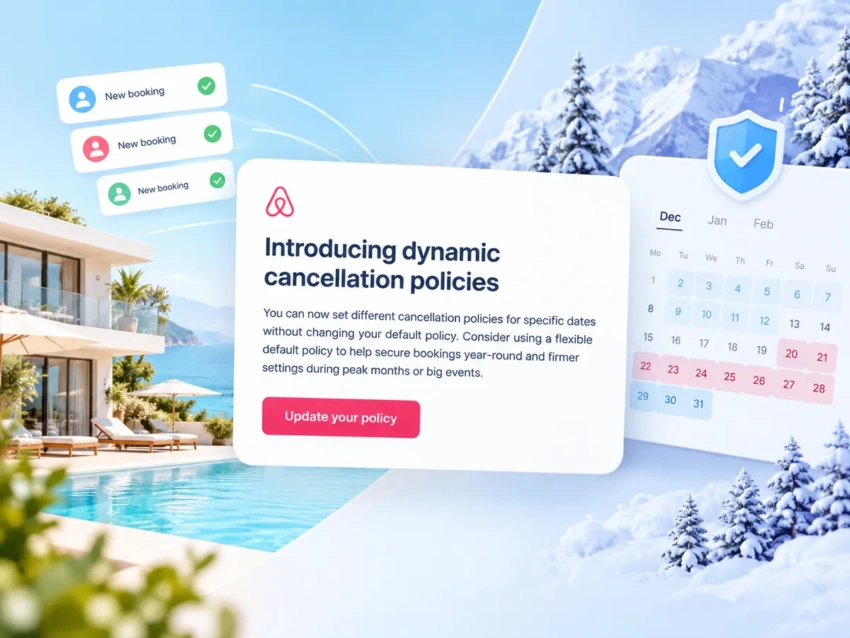
The official Airbnb rollout of dynamic cancellation policies
This created a classic dilemma for property managers. Hosts had to make a painful choice:
- Choose a strict policy. This protected the calendar but drastically cut conversion rates during the off-season, when guests are afraid to risk their money.
- Choose a flexible policy. This generated many bookings but left the host completely vulnerable to last-minute cancellations during peak dates.
Now this problem has been solved. A new, incredibly convenient feature allows hosts to select a separate, custom cancellation policy for a specific period on the calendar without changing the base settings for the entire property.
You can use the Flexible policy by default to ensure a steady stream of bookings year-round, while setting stricter rules for peak months or during major events. The host simply selects the desired dates (for example, June 7-12) and applies the appropriate strictness level (Flexible, Moderate, Limited, or Firm) from the platform’s standard list.
How to Use Airbnb Cancellation Policies
as a Marketing Tool
Many hosts view cancellation policies solely as a shield – a tool to protect against unscrupulous guests. But in professional revenue management, it is first and foremost a marketing lever.
Peculiarities of cancellation policies during low season
During the off-season, demand drops, competition among properties increases, and travelers’ planning horizons become less defined. During this period, “booking hesitation” comes to the forefront. Guests aren’t sure whether they’ll be granted time off, whether their plans will change, or whether their flight will be canceled.
This is exactly where the Airbnb dynamic cancellation policy unleashes 100% of its potential. During the off-season, you can attract targeted bookings with the most flexible and guest-friendly cancellation policy. What does this mean for your business?
- Lowering the barrier to decision-making. Guests aren’t afraid to make a reservation because they know they’ll be able to cancel it closer to their trip without financial penalty if their plans change.
- Increased lead time. People are more willing to book accommodations 3-4 months before their trip, knowing they have nothing to lose. You receive funds in your account (or guaranteed occupancy) much earlier than your competitors.
- Increased visibility in Airbnb’s algorithms. OTA (Online Travel Agencies) algorithms always prioritize listings that are convenient for guests. Flexible policies rank higher.
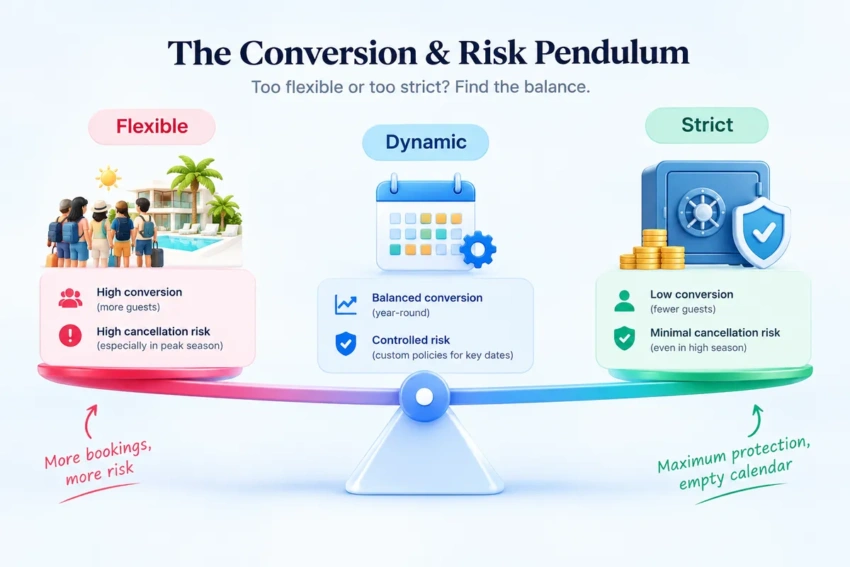
How dynamic settings help hosts find the perfect balance between bookings and risk
To clearly illustrate why static settings no longer work, we’ve created a matrix that doesn’t simply replicate Airbnb’s rules but highlights the hidden business implications of choosing one policy over another during different seasons.
How cancellation policies affect guest behavior and host economics
| Cancellation policy type | Conversion impact (low season) | Financial risk to host (high season) | Guest psychology (why they book or leave) |
|---|---|---|---|
| Flexible | Maximum (+30% views). Ideal for filling calendar gaps. | Critical. A guest can hold a booking “just in case” and cancel 24 hours prior. Resell window is lost. | “I’ll book this right now so I don’t lose it. If plans fall through, I’ll just cancel for free.” |
| Moderate | Good. A balance between conversion and protection (5-day window). | High. 5 days is rarely enough to find a new guest for luxury villas on peak dates. | “5 days is enough time to finalize my travel plans. This works for me.” |
| Firm / Strict | Low (-40% bookings). Guests leave for competitors with lenient rules. | Minimal. You are guaranteed a payout (partial or full) even if the guest no-shows. | “I’m not risking $2000 three months in advance. I’ll find a place that doesn’t freeze my money.” |
As the table shows, applying a strict policy during the off-season kills your business, while applying a flexible one during the peak season puts it at risk of bankruptcy. That is precisely why the ability to switch between these statuses depending on the dates is a lifeline for any property’s finances.
Dynamic cancellation policy and high season
While we use flexibility as a magnet for leads during the off-season, the rules change dramatically during peak season. New Year’s holidays, the summer peak, school breaks, or local mega-events (such as major music festivals) are periods when hosts earn the lion’s share of their annual profit.
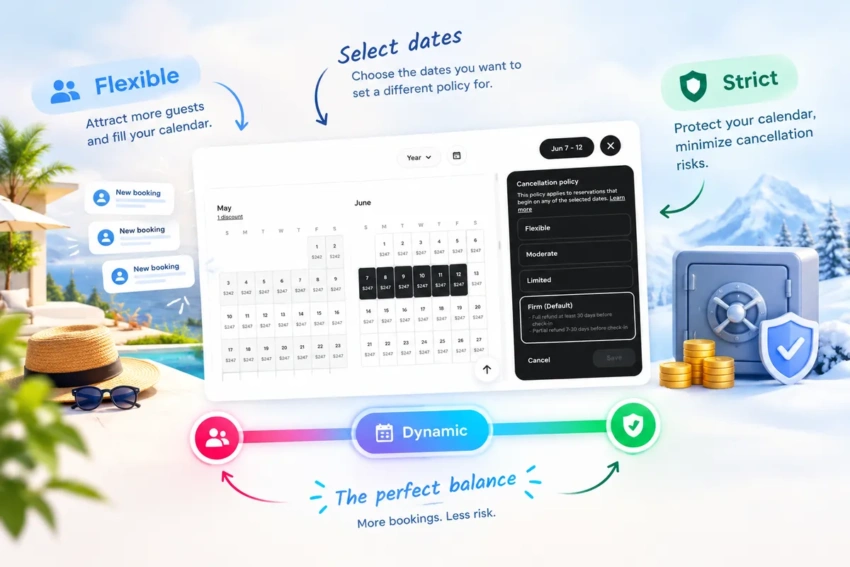
Applying a Strict cancellation policy to specific peak season dates
It is precisely during these periods that the new option becomes a reliable financial shield. It protects hosts by allowing them to set strict cancellation policies only for specific “prime” dates.
Why is this critically important?
During peak season, the management company’s main goal is to fill the calendar as early and as fully as possible, since this is the period with the greatest earning potential. Receiving a booking with a lenient cancellation policy during this period is an extremely undesirable and risky scenario.
Imagine a guest books your luxury villa for Christmas with the “Flexible” option back in September. You close out the calendar. But 48 hours before check-in, the guest clicks the “Cancel” button. For the host, this is a disaster: finding a new guest for a luxury property in just 2 days, in the middle of the holiday season, is practically impossible. You’re losing the opportunity to earn money during the most profitable time of the year.
Dynamic settings eliminate this risk. By setting the status to “Firm” or “Strict” for peak dates, you:
- Reduce the risk of last-minute, impulsive cancellations.
- Encourage guests to make well-considered, informed decisions before booking.
- Receive a rock-solid financial guarantee (payment is guaranteed even in the event of a last-minute cancellation).
- Accurately forecast your management company’s cash flow.
To put theory into practice, we’ve developed a basic revenue management framework that you can apply to your listings today. This table shows exactly how to combine policies in different market situations.
Practical scenarios for applying dynamic policies throughout the year
| Period / market situation | Recommended policy | Strategic goal of the management company |
|---|---|---|
| ‘Dead’ season (very low season) | Flexible | Maximum capture of any demand. Removing all booking barriers. The main goal is to cover operational costs. |
| Shoulder season (transition) | Moderate | Finding balance. Conversion is still important, but guests who cancel 1-2 days before check-in must be filtered out. |
| High season (summer, holidays) | Firm | Calendar protection. Blocking dates only for real guests ready for financial commitments. |
| Major local events (concerts, expos) | Strict / non-refundable | Avoiding speculative bookings. Capturing high profits from demand spikes with no risk of chargebacks. |
| Newly launched listing | Flexible (first 3-5 bookings) | Rapidly gathering initial reviews to boost Airbnb algorithms, regardless of the season. |
6 Reasons Why Premium Properties Need
Dynamic Cancellation Policy on Airbnb
All of the risks described above increase significantly when it comes to the luxury segment – villas, penthouses, and exclusive residences. For hosts managing high-end properties, Airbnb’s dynamic cancellation policy is an essential tool for protecting unit economics.
Here’s why luxury properties must use this tool:
1. Enormous financial stakes
The difference lies in the scale of the losses. While in the economy segment, canceling a studio reservation means a loss of $100 per night, a late cancellation of a villa rental can wipe out between $5,000 and $15,000 in a single weekend.
In the premium segment, the margin on a single transaction is too high to rely on a basic flexible policy. Dynamic settings allow you to lock in revenue for specific dates without the risk of sudden cancellations by guests with a single click.
2. Long transaction cycle (lead time)
Audiences that rent premium properties don’t make decisions on a whim. The transaction cycle takes anywhere from a few months to half a year. According to analytics from Airbnb’s official Newsroom, large family and group trips are planned well in advance.
During this entire time, if your policy remains flexible, your calendar remains in limbo. Implementing strict rules for these long-term but high-value bookings eliminates the risk of your inventory being tied up for an extended period without generating revenue.
3. Complex logistics and associated costs
A luxury vacation is a complex puzzle. Guests need to coordinate schedules, purchase business-class tickets, hire a private chef, or book a transfer. The host also incurs upfront costs: preparing premium welcome baskets, arranging for a cleaning service, heating the pool, or hiring a concierge.
If you allow a guest to cancel for free a couple of days before arrival, your business is effectively taking on the risk of all these logistical chains. A strict policy for peak dates shifts the financial responsibility back to the guest.
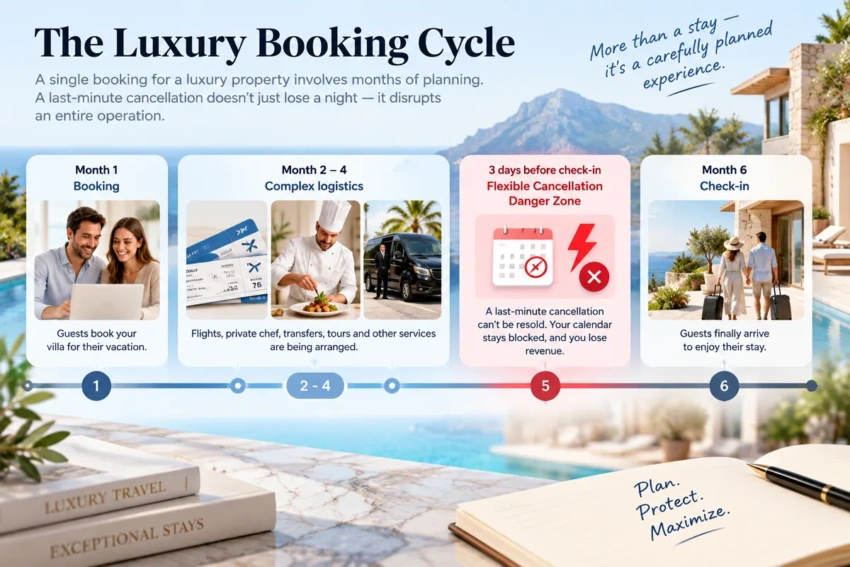
The luxury booking journey and why last-minute cancellations are devastating
4. Virtually zero potential for last-minute resales
Imagine that an Airbnb Luxe listing becomes available due to a cancellation three days before New Year’s Eve. Finding a “last-minute traveler” who suddenly decides to spend $10,000 and fly in immediately with their family is, mathematically speaking, nearly impossible.
Last-minute travelers are looking for discounts, not the premium segment. Canceled luxury bookings simply go to waste, turning into a net loss.
5. Dependence on local mega-events and holidays
Luxury properties often generate up to 40% of their annual revenue during specific events. These can include the Cannes Film Festival, Art Basel, or the Coachella music festival. During these periods, demand far exceeds supply, and prices skyrocket by 200-300%.
Protecting these specific dates with “Firm” or “Strict” status using a dynamic cancellation policy ensures that you block speculative bookings (when guests book multiple villas at once “just in case” so they can later cancel the extra ones) and don’t lose out on windfall profits.
6. Professional yield management
A dynamic cancellation policy allows management companies to operate like true hoteliers. You maintain the most loyal and flexible terms during “off-peak” months – this lowers the barrier to booking, reassures guests, and allows you to draw traffic away from competitors who have forgotten to update their settings.
At the same time, you strictly lock down high-demand holiday weeks with strict rules. You achieve both high conversion rates during the off-season and guaranteed revenue during peak periods.
As a conclusion of all the above
The implementation of the dynamic cancellation policy for your Airbnb listings is a powerful tool that benefits both sides of the platform.
For guests, this means more freedom, confidence, and peace of mind when booking during periods when flexibility is truly important to them. For hosts and management companies, this is a long-awaited opportunity to protect their most valuable, high-margin dates, drastically reduce the risk of last-minute cancellations, and develop a professional revenue management strategy.
In fact, Airbnb has given professional hosts the leverage to tailor their cancellation policies to the true pulse of their business – seasonality. Calendar management has never been this flexible, secure, and effective.
If you own a property in the Dominican Republic, our expert team is ready to organize a smooth, secure, and hassle-free property management and help maximize your passive income.
Learn About Our Management Approach
FAQ on Dynamic Cancellation
Policy on Airbnb
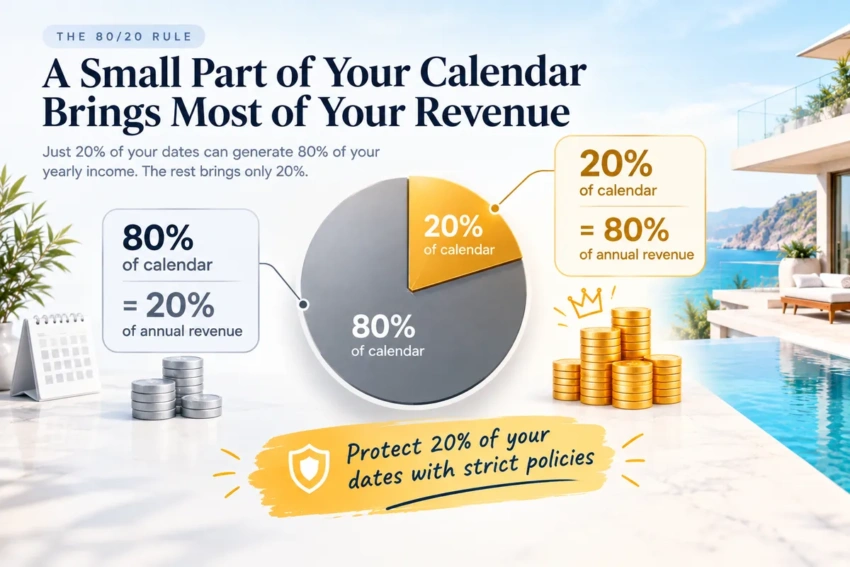
Protect the 20% of your calendar dates that generate 80% of your revenue
What is the 80/20 rule in Airbnb?
In short-term rental revenue management, this is the classic Pareto principle: just 20% of the calendar’s peak dates (New Year’s holidays, peak season, major city events) account for 80% of a host’s annual net profit.
Late cancellations during these 20% of dates can completely wipe out a property’s annual profitability.
This is precisely why dynamic cancellation policies are critical: they allow you to strictly lock down (Firm or Strict) the key 20% of the calendar while maintaining flexibility (Flexible) for the remaining 80% of dates to maintain high conversion rates.
Can I get a full refund if I cancel my Airbnb?
Yes, but only under strictly defined circumstances:
- In accordance with the host’s policy. For example, 24 hours before check-in under a “Flexible” policy, or 5 days before check-in under a “Moderate” policy.
- During the 48-hour grace period. If the reservation was made at least 14 days before check-in (applies to most standard policies).
- By mutual agreement. If the host voluntarily agrees to issue a refund through the Resolution Center.
- Under the AirCover protection program. If the host failed to provide access to the listing or the listing has critical defects.
What will Airbnb's cancellation policy be like in 2026?
In 2026, the platform finally transitioned from a static “one rule for the entire year” model to dynamic cancellation policies:
- Hosts gained the ability to set different levels of strictness for specific dates and seasons directly in the calendar.
- The “Non-refundable” option has been standardized (guests receive a 10% discount in exchange for waiving their right to a refund entirely).
An updated Major Disruptive Events Policy is now in effect, which excludes typical weather events and personal circumstances from the list of valid reasons for forced cancellations.
Does cancelling Airbnb affect your rating?
It depends on who initiates the cancellation on the platform:
- Cancellation by the guest. Does not lower the property’s star rating in any way and does not affect its position in search results.
- Cancellation by the host. Results in severe penalties from the platform: an automatic fine (up to $1,000 depending on the timing), loss of Superhost status for at least 1 year, blocking of dates on the calendar, and the publication of an automatic negative review on the listing’s profile.
What is the strictest cancellation policy on Airbnb?
For standard accounts, the strictest policies are “Firm” (full refund only 30 days before check-in) and “Strict” (full refund only within the first 48 hours after booking, provided there are at least 14 days until check-in).
When combined with the Non-Refundable option, the reservation becomes completely non-refundable from the moment of payment, regardless of the time remaining until check-in.
For large management companies connected via PMS / Channel Manager, specialized Super Strict 30 and Super Strict 60 policies are also available.
Can Airbnb force a host to refund?
Yes. The platform intervenes and initiates a forced refund, overriding the host’s policy, in two cases:
- AirCover for Guests. In case of serious issues with the accommodation (AC not working in hot weather, dirt, unpleasant odors, misleading description) that the guest reported to customer support within the first 72 hours.
- Major Disruptive Events Policy. In the event of official government travel restrictions, natural disasters, or military operations in the region.
How many cancellations does Airbnb allow?
It all depends on who is making the reservations – the guest or the host:
- For guests. There is no formal limit, but frequent, repeated cancellations are tracked by the platform’s security algorithms and may result in a temporary suspension of your profile.
- For hosts. The limits are extremely strict. To maintain Superhost status, the cancellation rate due to the host’s fault must be strictly less than 1% (no more than 1 cancellation per 100 reservations). If cancellations occur regularly, the listing will be deactivated.
Does Airbnb penalize guests for cancelling?
Airbnb does not assign penalty points to guests’ profiles, but does impose direct financial penalties:
- Deduction of the cost of the nights in accordance with the cancellation policy the host has set for those dates.
- The Airbnb service fee is not refunded to the guest if the cancellation occurs after the free cancellation window has ended or if the guest has made more than 3 cancellations in the last 12 months.
Can Airbnb hosts see past cancellations?
No. To protect privacy, Airbnb does not disclose a guest’s cancellation statistics to the host until the reservation is confirmed. The host can only see the guest’s profile verification status, time on the platform, and public reviews from other hosts.
That is why protecting your calendar with Firm’s dynamic rules during peak dates is the only reliable way to filter out frivolous bookings.
Do Airbnb guests get penalized for cancelling?
The amount of the cancellation fee depends entirely on the host’s settings for a specific period:
- With the “Firm” dynamic setting for peak dates, the guest forfeits 50% of the stay cost if they cancel between 7 and 30 days before check-in, and 100% of the cost if the cancellation occurs less than 7 days before check-in.
- The cleaning fee is always refunded to the guest if the reservation is canceled before the actual check-in date.
What is the 90 day rule for Airbnb?
Depending on the context, this term refers to:
- Municipal restriction (90-day rule) is a legal limit on renting out an entire property in certain major cities (such as London), where, without a special commercial license, a property may not be rented out for a total of more than 90 nights in a calendar year.
- For reservations of 28 nights or more, a separate long-term cancellation policy automatically applies, under which, in the event of cancellation, the payment for the first 30 days of the stay is not fully refunded to the host.
How to get 100% refund on Airbnb?
A full refund (including all fees) is possible only in 4 situations:
- The cancellation was made strictly within the free cancellation window specified in the host’s policy for those dates.
- The cancellation is made within the first 48 hours after the reservation is made (for reservations made 14+ days in advance).
- The trip was canceled due to a confirmed global force majeure event covered by the Major Disruptive Events Policy.
- The host has personally confirmed their agreement to a full refund in correspondence or through the Resolution Center.
What are valid reasons for Airbnb refunds?
The platform recognizes only the following as valid reasons:
- Officially declared national emergencies.
- Sudden government-imposed travel restrictions or border closures.
- Natural disasters that make it physically impossible to stay at the property.
Important for hosts. Illness, injury, flight cancellations, or bad weather are not valid reasons starting in 2024-2026. In such situations, Airbnb directs guests to contact their insurance companies.
What is a good excuse to cancel Airbnb?
From the perspective of the platform’s rules, there are virtually no valid reasons for a unilateral, free cancellation outside the listing rules.
If a guest writes, “My plans have changed / my child is sick / my flight was delayed,” the host is legally protected by the established cancellation policy.
The professional response from the management company in such a case is to politely decline a manual refund, retain payment in accordance with the rules, and recommend that the guest seek compensation through their personal travel insurance policy.
Updated on: . Author: